
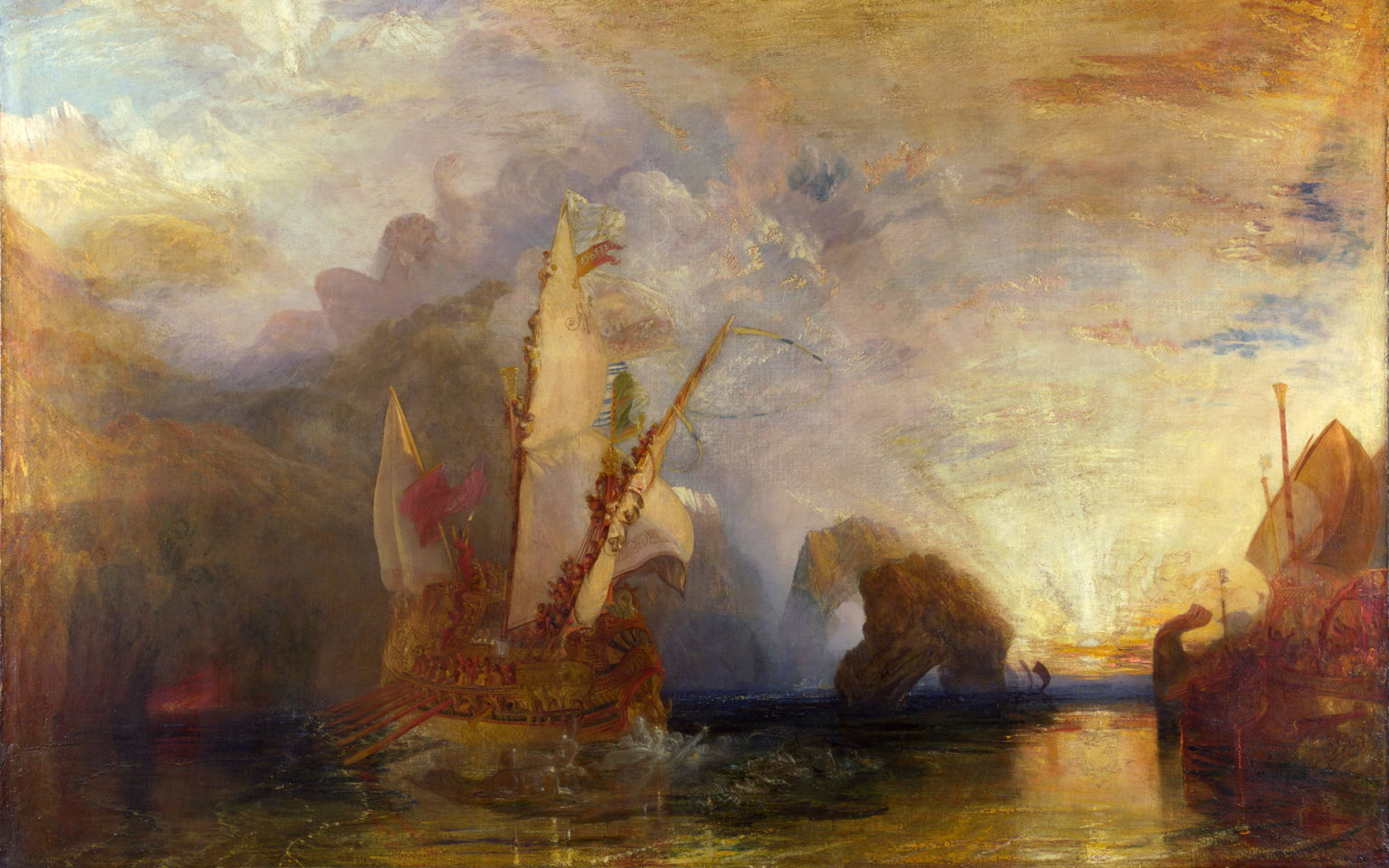
Joseph Mallord William Turner, Ulysses Deriding Polyphemus, 1829
Tina Li
Transient World: On Translating Poetry
By Arthur Sze
Copper Canyon Press. 160 pp. $17.00
Do we still need human translators? In January, Harlequin France, a romance imprint of HarperCollins, fired its translation team and outsourced their work to an AI-powered service called Fluent Planet. Following the contentious announcement, Fluent Planet reported increased interest from other publishers. A 2025 study by Microsoft researchers found that interpreters and translators were the easiest occupations to replace. As large language models begin to displace translators of technical prose and genre fiction, how long before all translation jobs become jeopardized? Poetry, with its intricate demands of form, sound, and meaning, might seem to require a human translator. But AI poetry translation tools already exist, and some argue AI can grasp the relationships between words and language as well as any human. What, then, is unique about the work of human translators that is worth preserving?
In a new book titled Transient Worlds: On Translating Poetry (2026), Arthur Sze has given us an anthology, a guide, and a call to action. The 25th U.S. poet laureate has put together a new selection of translated poetry in thirteen different languages and spanning over a millennium. Instead of chapters, the poems are organized into fifteen “interpollinating zones” that Sze encourages readers to freely move between. He offers appreciative readings of each poem and considers the translation techniques involved in its making.
Among poet laureates, Sze is the first to focus his term on translation. He first began writing poetry in his first semester at MIT in 1968, when he got bored in a calculus lecture and started scribbling verses on the back of his notebook. After his sophomore year, he transferred to UC Berkeley, where he wrote poetry under the tutelage of Josephine Miles, the first woman ever tenured in the English department there. Then, after a brief stint as a construction worker, he greatly helped to develop the creative writing program at the Institute of American Indian Arts in Santa Fe, New Mexico.
Translation, Sze has said, has been critical to his maturation as a poet. Studying Tang dynasty poetry while at Berkeley introduced him to a centuries-long lineage and helped him break through the strictures of writing and thinking in one language. Maize god, daikon, diffraction, Red Guard, shoelace, napalm, z twist, ice floe, caesura—these are a few of the startling nouns that dot the pages of his twelve collections of poetry. His poems tend to be both scientifically grounded and contemplative, drawing especially from Taoism and Buddhism. Though Sze writes largely in English, he has used and adopted words from Chinese, Spanish, Japanese, and Hopi. He has advocated for what he calls the “horizontality of language:” an imperative not to privilege any word or writing system over another.
When Sze decided to undertake an anthology of poetry in translation he must have been acutely aware that he would only be able to fully analyze Chinese translations. To remedy this, he calls for help and makes do with what he knows. In Zone Fourteen on Mirabai, a 16th century mystic poet from Northern India, Sze includes an interview with the translator Chloe Martinez. He begins: “I of course can’t read Mirabai in the original [Braj Bhasha], but as I look at the text and your translations, it seems to me you’ve unpacked and loosened them to fit into contemporary speech.”
A translation should also sound and read well on its own. When comparing translations of Sappho’s “Fragment 31,” Sze analyzes each version’s movement and immediacy by examining verbs, word choice, forms, enjambment, and bracket placement—all without any knowledge of Greek. Though he can’t comment on the complex decisions behind every word choice, Sze’s attitude of earnest engagement animates Transient Worlds. He recognizes his limitations but trusts his ability to pay attention.
Throughout the zones, Sze situates the reader in the poet’s biography and historical context, as when he contextualizes the spiritual weight of Mount Fuji in Kobayashi Issa’s haikus or the complexity of the Palestinian diaspora in Najwan Darwish’s poem “We Never Stop.” Only when Sze examines Chinese poems do the other sections seem insufficient in comparison. When discussing Lao Tzu’s Tao Te Ching, he explains the history and science behind indigo silk dyeing, an ancient Chinese textile tradition. He then theorizes about the character 玄, which contains a pictorial component meaning “silk” and could mean “dark, mysterious, and profound,” or, as he recalls a Japanese student of his at the IAIA once proposing, “almost disappearing.”
In Transient Worlds, Sze features Danish, French, Greek (twice), German, Russian, and Spanish; Chinese (twice) and Japanese; Arabic and Hebrew; Braj Bhasha; and Navajo and Tzeltal. Swaths of the world—sub-Saharan and North Africa, southeast and central Asia, and Oceania—are notably missing, and Sze only provides the reader resources to translate two Chinese poems. But with just fifteen zones and 149 pages, it’s impossible to cover everything. And by engaging so deeply with what he has included, he opens the floodgates to encourage the reader to participate in his project on their own terms.
********
Many have fixated on the shortcomings of translation. American poet John Ciardi called it the “art of failure.” The Russian-Jewish poet Hayyim Nahman Bialek said “reading a poem in translation is like kissing a woman through a veil.” In Soviet filmmaker Andrei Tarkovsky’s 1983 Nostalghia: “Poetry is untranslatable, like the whole of art.” But what would happen if we relaxed about what is lost and focused instead on the gain? What if we read a translated poem not with a grudging tolerance, but as a new poem in itself? In the introduction to Transient Worlds, Sze notes that
The word translate comes from Old French, which itself comes from the Latin translatus, meaning “to bring over, carry over.” So, we might find literary translation to be a process of carrying over all the sound and sense of an original poem into a new language. But then the Italian phrase traduttore, traditore comes to mind. This cliché— “translator, traitor”—suggests that a translation is an inferior version of the original, that because it cannot carry all of the original, it is unfaithful to it. Now, if a translator attempts the impossible task of bringing a poem from one language into another without loss, they might well betray the meaning and intention of the original poem; but if the translator recognizes the many possibilities for meaning that this carrying-over affords them, they will embrace the process of transformation and renewal that is translation, and better reflect the original’s networks of meaning.
The possibilities of carrying-over include technical innovations and novel attempts to convey old images. But just as absolute fidelity in trying to translate a poem can be disastrous, so too can trying to improve upon a poem with intentions beyond the original. In “Nineteen Ways of Looking at Wang Wei,” American writer Eliot Weinberger points out the “Western conceit” in Chang Yin-nan and Lewis C. Walmsley’s co-translation of a Wang Wei poem. They frame the empty mountain setting as “lonely” and embellish an otherwise peacefully simple scene. It is the “product of a translator’s unspoken contempt for the foreign poet,” Weinberger writes, adding that translation requires “the dissolution of the translator’s ego: an absolute humility toward the text.”
A translator succeeds by embracing new possibilities while allowing herself to be a conduit for the original. In Zone Five, Sze examines the book-length poem Memorial, in which British poet Alice Oswald attempts an “excavation of the Iliad.” She departs radically from Homer’s tale in form but holds tight to it in emotion. She begins:
The first to die was PROTESILAUS
A focused man who hurried to darkness
With forty black ships leaving the land behind
Men sailed with him from those flower-lit cliffs
Where the grass gives growth to everything
Oswald covers the litany of warriors who died in the Trojan War, describing their families and character and lovers, before ending with Hector. She prefaces Memorial by explaining that she wrote “through the Greek, not from it—aiming for translucence rather than translation.” Borrowing the Homeric techniques of catalogues and mythic descriptions but foregoing fidelity to the plot, Oswald mainly aims to capture the onslaught of violence and death and loss in the Iliad. Sze argues she adds something more: She “reclaims” the fallen warriors in the original Homer who used to be mere names. He endorses her attempt as “translation of the highest order.”
At the same time, Sze takes a more radical position, arguing that a poet interested in translating can try even if they don’t know the language—so long as they’re diligent and have a trusty intermediary. A dictionary can always be found, but what about a friend? In Zone Ten, Sze recounts how American poet Carol Moldaw asked her friend who grew up in Russia, Irina Ross, to help her translate the 20th-century poet Marina Tsvetaeva. Ross chose poems for Moldaw to translate so Moldaw wouldn’t be influenced by looking at translations. She provided her recordings of pronunciations, as well as transliterations of the Cyrillic and a crib (a word for word translation). “Translation involves building bridges, and here it can be between people,” Sze reflects.
In the first zone of Transient Worlds, Sze hands the reader puzzle pieces of Tao Qian’s poem “Drinking Wine”: each character, its pronunciation, and various English definitions. If you don’t know Chinese, you might not grasp the complexities of each character’s components, know how grammar shapes each line’s meaning, or understand the culture and history behind certain images. But you have the ingredients. You can try to pronounce it yourself to hear the sound of the poem and its shape, and you can ruminate on each character’s possible meanings. Of course, if a writer only knows one language and she’s interested in translating, she should learn the language they want to work in. In the meantime, though, there’s no reason she shouldn’t translate. Sze closes out his anthology by echoing Rainer Maria Rilke’s imperative, “Live the questions now.”
*******
In a 1928 introduction to Ezra Pound’s Selected Poems, T.S. Eliot predicts that Pound’s landmark translation of Cathay will soon be considered a “magnificent specimen of XXth Century poetry” rather than just “a translation.” “Each generation must translate for himself,” Eliot proclaims. That’s not to lament Pound’s efforts or the efforts of any translator before this century, but to reaffirm the need for continued, energetic translations around the world. In Transient Worlds, Sze writes that “as language is always evolving, speech patterns, syntax, and vocabulary always shifting, translations are by nature ephemeral.”
Who will supply the translations of today and the future? Sze argues that it’s not going to be the machines. When a translator works, they’re holding, all at once, the poem’s meanings, images, and voice; the original language; their preconceptions of that language, its culture and subcontexts; and their own. Without true subjective experience—such as a cultural background and thus the capacity for bridging across cultures—it seems unlikely AI could write more than literal, mechanical translations. Sze argues that
A good translation draws on cross-cultural understanding, and the language has to come alive. If a translation sounds like a translation, you have failed in your effort. A good translation appeals to our ears, eyes, and heart; it is a singular endeavor and a humanizing act that makes the ancient contemporary, the foreign accessible, and the emotional, intellectual, and spiritual music of the human interior universal.
In his essay “To write is to translate,” Portuguese poet José Saramago explores the untranslatable nature of the human spirit. When a poem crosses from the poet’s mind to the page, something is added—form—in order for the original emotion to survive in transit. When a poem moves from one language to another, something else needs to be added in order for the cultural, historical, or political contexts to carry over. Saramago calls this an “alchemical passage in which what is needs to transform into something else to continue being what it had been” (emphasis mine).
In his poetry, Sze often revels in the beauty of the gap between reality and perception, of the transience of meaning. In his poem sequence “Before Completion,” he asks, “ Do the transformations of memory / become the changing lines of divination?” In “The Curvature of the Earth,” he recalls how “Hunting for / a single glow-in-the-dark jigsaw piece, / we find incompletion a spark.”
********
It can be easy, when reading a translated poem, to think, this is it. We feel that the translator has done it. The poem has been translated, the process is complete. When I’ve read one translation enough times, I struggle to conceive of the poem any other way. After first studying Fagles’ translation of Sarpedon’s speech in the Iliad—“Ah my friend, if you and I could escape this fray…”—I found Lattimore’s version unbearably clunky—“Man, supposing you and I, escaping this battle…” Seeing translation as a one-and-done act, however, fed into a certain anxiety when I first considered trying to translate: Beyond my shaky grasp of Mandarin, I was afraid to undermine authority.
But Sze is a gentle guide. In the appendix, he includes writing prompts based on several poems anthologized in Transient Worlds: an ekphrastic poem like Rilke’s “Archaic Torso of Apollo”; a visual one in the style of Apollinaire; and a series of haikus following Kobayashi Issa. He encourages the reader to try translating a Li Bai poem, “Question and Answer in the Green Mountains.” Under each character, Sze provides a pronunciation and transliteration. He also shares his own translation:
You ask me why I live in the green mountains;
I laugh and don’t answer—I’m at peace.
Peach blossoms on flowing water go into the distance.
There is another sky and earth not among men.
Behind Sze’s open invitation to translate is the same logic behind his humble yet confident analysis of translations from languages he doesn’t know. The reason why AI cannot translate poetry is the same reason why every human can learn to. There is no ultimate translation. Otherwise, the process could be automated to perfection. We each encounter a poem from our unique preconceptions and backgrounds and desires. Every translation is a new collaboration between two thinkers. Translation itself is an attempt to learn.
“Translation, after all, builds bridges and makes connections,” Sze writes. “The more we give, the more everyone has.” Talking about translating poetry, we find ourselves talking about much more. When Moldaw asked Ross to spend hours recording and transliterating Russian poetry for her, she was also asking about her culture and homeland. Bringing a translation to an editor is to ask for a conversation.
Including my translation here is to ask you, the reader, to imagine with me and to have faith in me. I grew up speaking very rudimentary Mandarin at home and last year I took intermediate modern Chinese. Here I go:
Why is my home in the bluegreen mountains?
I smile as there’s no answer but my heart rests here
Peach blossoms flow downstream and disappear
Here is a sky and earth where no men roam.
Tina Li thinks everything is poetry and that you are poetic.