
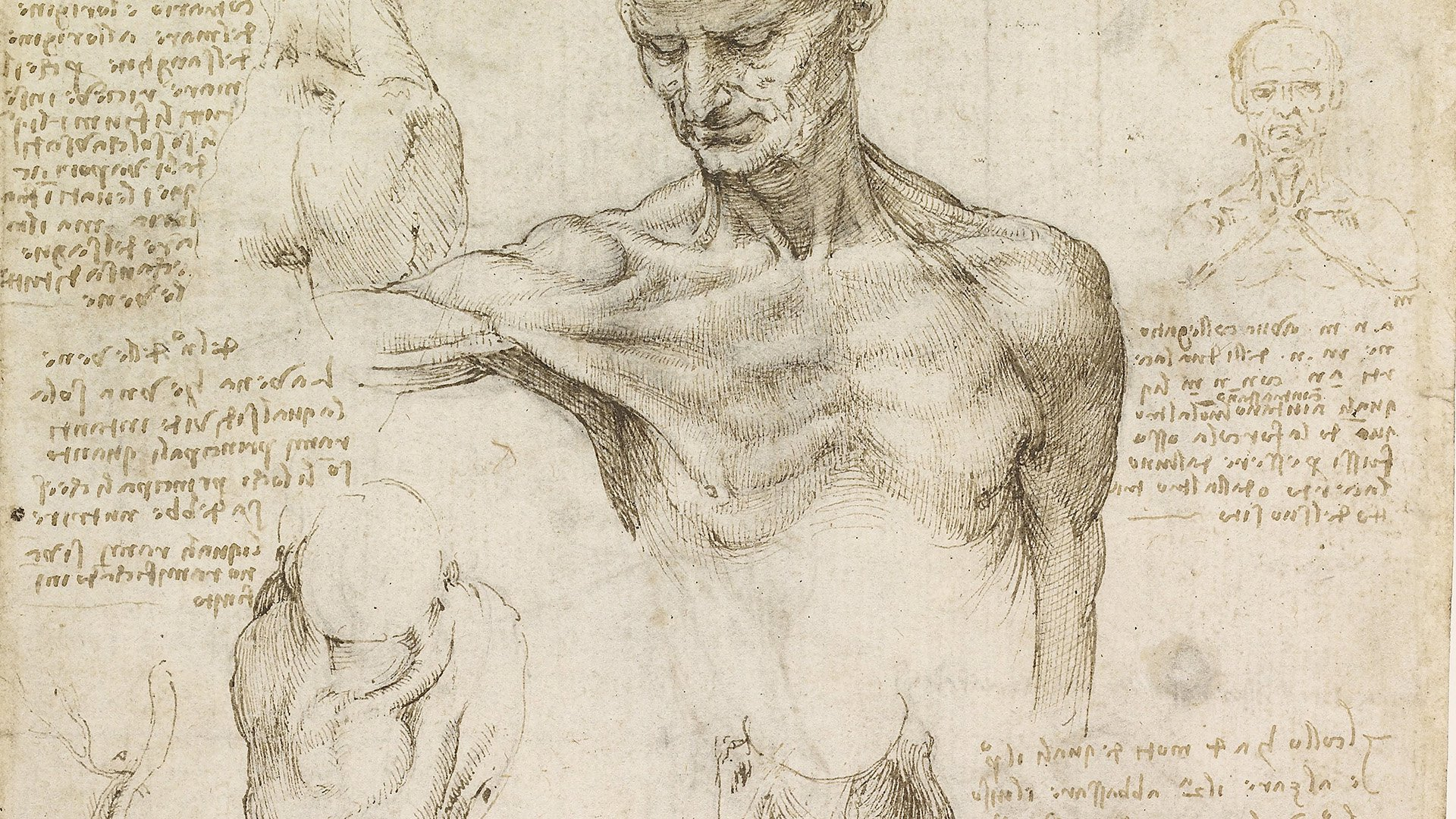
Leonardo da Vinci, drawings from Anatomy of the Neck, 1510
Samantha Liu
Little Pharma
By Laura Kolbe
University of Pittsburgh Press. 128pp. $20.00
I spent the summer of 2024 working in the emergency room of Manhattan’s Bellevue Hospital, the country’s oldest public hospital. It was an incoherent experience: Patients came wheeled in after shootings and hit-and-runs and afterschool brawls; after falls, slips, trips; after weddings and birthdays and Fourth of July fireworks set awry. Some people’s hearts stopped, and then they survived. Others didn’t.
Every day that summer I tried to write, and every day I found myself without words. After my first overnight shift, I dragged myself out of the clinic and down toward an East Village bookstore, where I found a copy of Laura Kolbe’s Little Pharma, a collection of poems that follows the author’s own descent into the medical underworld. Kolbe, who is a poet as well as a physician at New York-Presbyterian Hospital, scrutinizes the workings of the clinic under an often dazzling—sometimes ruthless—poetic gaze. The project takes after a small but mighty tradition of physicians-turned-writers, including those who wrote explicitly about medicine (e.g. Atul Gawande, Mikhail Bulgakov), and those who decidedly turned elsewhere (e.g. Khaled Hosseini, John Keats). Central to them all is a preoccupation with translating the far-ends of human experience—death, care, suffering, hope—into words. In Little Pharma, Kolbe searches for a new language to look up-close at the body and its limits, or maybe just to confess that she is woefully unprepared for it. At its heart, Little Pharma asks: What gets lost when we try to anatomize?
*
With an English degree from Harvard, Kolbe understands that dissection is nothing if not an act of close-reading. After all, a medical chart is just a text, a life collapsed into a narrative line: 35yo woman, 5’9” and 135 lbs, history of hypertension, presents to the ED…
At their best, Kolbe’s poems read like a feat of reconstructive surgery. Scalpels, PET scans, and histology slides are her instruments for deconstruction, with which she cuts into “the anatomist’s awe of layers.” The poet is unafraid to get atomic, down to “the recessed bonsai buds [that] fold zirconic / on the meditation terrace of your flesh.” The book’s commitment to scientific rigor went mostly unremarked upon when it first came out in 2021. Critics offered back-cover platitudes about “scintillating metaphysical poetry” and an “ongoing spiritual journey.” But Kolbe writes of miracles firmly rooted in molecular logic: “Like you could peer under her ponytail and see sky,” she says, describing a woman’s astrocytoma, a brain tumor that afflicts the star-shaped astroglial cells. There is something wonderful about seeing physiological facts animated by metaphor in this way, the body broken down into a billion spinning particles.
And then there are all the things lost in dissection. Even as it gets down to the molecular dimensions of the body, Little Pharma remains skeptical about the possibility of a world “at last…solved” by rationalist empiricism. There is a clinical exactitude to the poems’ tone, as if drawn from a textbook asserting the authority of science over nature—only to reveal its own limits. Take the title of one poem, “Cadaver 28,” which recounts a medical student’s first face-to-face encounter with a human corpse. She studies the body, cares for it with terrifying intimacy, even imagines morbid valentines exchanged with it. By the end of her medical training, she can lay out “each piece petaled / and glossy, transected and fanned out for sight / parody of fidelity.” The last three words come like a sucker-punch to the chest. The scientific method, for all its rigor, amounts to little more than a “parody” of truth. I understand “Cadaver 28” as an anti-love poem, perhaps telling us that neither love—nor a life—can come in pieces. Maybe Heisenberg and the quantum physicists said it best: The closer we get to something, the more we are left with uncertainty.
*
Little Pharma won the Agnes Lynch Starrett Poetry Prize in 2020 and was named a Boston Globe 2021 Best Book of the Year. Its accoladed reception coincided with the height of a worldwide pandemic and a long-awaited reckoning with the American healthcare system. Five years later, in the wake of the government’s slashing of $1 trillion in federal funding for the Medicaid program and the National Institutes of Health’s halting of all studies relating to race and gender minorities due to their being “antithetical to scientific inquiry,” the health system remains a battleground for political and poetic contention.
The recent attacks on healthcare—which narrowed the set of lives worthy of care or study—have accompanied a conceptual shift that insists on treating human beings as divisible, manageable units. There is a certain cruelty to the Western medical paradigm which fundamentally views people as “parts, a lessening.” In “Little Pharma’s Course in Sonography,” Kolbe satirizes a lesson in the technique which images a patient’s onto a flattened two-dimensional, black-and-white telescreen. “Nothing escapes a method,” the speaker drones over and over, like the apathetic telephone-hold music of a customer service hotline. In what is perhaps the most well-known poem to come out of Little Pharma, “Buried Abecedary for Intensive Care,” Kolbe writes damningly against medical jargon (or euphemism, she’d call it). “[It is] called the vagus nerve when touching the neck makes the rhythm stop. Called weaning when the fentanyl hangs salivary at the chin of the bed.” She moves through the form like an incantation, bringing to bear the violence, devastation, and sheer terror buried underneath this thin veil of objectivity. The ending always leaves me breathless: “Called zeroing out when they reset the machines for the next body.
The unspoken harms of medicine manifest through the titular speaker, called Little Pharma, a shadow-double of Kolbe herself. Little Pharma contends with her complicity in a medical system that dehumanizes its patients, reducing them to statistics and hospital profits. She remembers room numbers and medical charts but not faces; she dons “my day-face, like a net of cathodes, drained / of all irruption.” Yes, as the name implies, she is a speck of Big Pharma. And yes, she has killed people. She has done harm, sometimes because of systemic flaws, and sometimes because of her own fallibility. The collection’s pages are haunted by the ghosts of patients dead, patients misdiagnosed, patients minimally conscious and only able to croak out “you terrible” to the doctor who noticed their brain-bleed too late.
But Little Pharma is also the kind of narrator who wonders if she could plant a garden in a hospital room, a “ruffling infancy of color.” In another poem, “tired of playing death’s white clerk,” she eats an orange in the middle of a glove closet. When meta-textual references invite Puck, Lady Macbeth, and Marianne Moore into the operating room, Kolbe seems to be searching for more compassionate ways she might inhabit the medical establishment. In her lines, patients she has met transform into birds, flowers, “bathed in quills, rattling / like singed paper”—descriptions that are tender and, sometimes, frustratingly opaque. Readers must grapple with these half-eulogies and half-fictions of people they never really knew. Kolbe’s poetry is not necessarily truth, nor is it supposed to earn her forgiveness. But it is her devotion to keeping her patients whole, unknowable, that invites readers to care for people they do not know and cannot see.
And just as soon as we think we’ve pinned down who Little Pharma might be, the final section yanks us outside the hospital. The veneer of Little Pharma falls away, and we are left with Kolbe in her own life—as her most frenetic self, “howl[ing] in time” to an “all-skelping flarehappy sun.” The section—feverish, loud, and kaleidoscopic—breaks drastically from what the prior hundred-something pages had built up, slamming the reader with the discrepancy between the speaker and the author. The final act shows us how the knowledge constructed in the hospital buckles when faced with the complexity and sheer chaos of the real world. “Make it confess to me that separation / is not protection, that though behind glass / I cannot hear the sidewalk talk, / the harping between clips of bridge-truss, / I can explode,” Kolbe writes. This poem is entitled “The Apparatus,” after the car she drives. It invites us to recognize that poetry—just like science—is an apparatus: a means of moving through the world while holding it at a distance. We are reminded of our constant endeavor to find answers in a world that stubbornly refuses interpretation. And just as our answer starts to crystallize, Kolbe accelerates out of the page, leaving us with ourselves, our hands, and the entropy of our own lives.
*
The first death I saw at Bellevue was a man who had jumped off the George Washington Bridge. He had been rushed unconscious to the trauma bay, where he continued to flatline after multiple resuscitation attempts. Finally, the doctors declared him dead. He wasn’t actually dead, I kept thinking. They just pronounced him dead. Surely words couldn’t cause a death. I waited for the entire world to bend and shatter under the senselessness of this. But then the nurse called for the paperwork, and the doctor started scribbling down “time of death,” and someone else fetched a body bag.
In my favorite poem from the collection, Little Pharma watches a man suffering from spinal cord compression “at the bathroom / sink, attempting dance, clutching the faucet’s chrome swan neck / in sacrifice. And not to fall.” By the end, the metaphor falters:
“When, pre-electric, we gave birds
to gods, we must have known
a snapped neck broke a downward
power, emptied space for other
currents in descent. We also
by this gesture cut off
feeling seeping center-up.
Perhaps explaining why we never
sensed an answer.”
Kolbe knows what it’s like to be bereft of explanations, scientific or spiritual. She reminds us that, in the face of reality, all logics are inadequate fictions. A diagnosis or an MRI scan can only bring us so close to the truth. So too with words.
Sometimes the body is poetry. Sometimes the body is just 5’9”, 35yo, 135 lbs, a smattering of molecules and a jolt of electricity. And more often, the body is just a body, trying to hold itself upright in the face of it all.
Samantha Liu thinks you’re cool.