
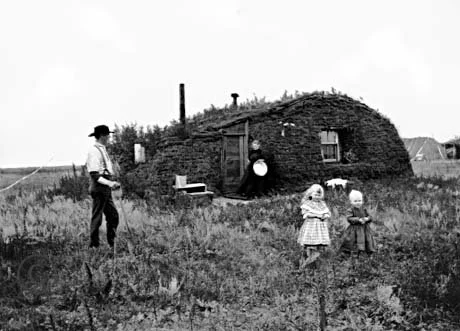
“Norwegian settlers in North Dakota, 1898” by A. Milton (public domain)
Jacob Harms
Yesteryear
By Caro Claire Burke
Knopf. 400 pp. $30.00
Caro Claire Burke’s first novel, Yesteryear, is a story without heroes. Natalie Heller Mills narrates the 400 pages of the book, recounting her modest rural upbringing, her college years at Harvard, and eventually her homestead in Idaho, which she buys with her barely serviceable husband, Caleb, and a baby on the way. She creates an Instagram account for the ranch the day they close on it. By the time the story picks up, Natalie has accrued over five million followers, with no small thanks owed to her personal social media coach and the endorsement of a podcast that lauds her as “a wife who knows how to do her job.” Natalie wakes up every morning an hour from the nearest town, tends to her chicks, bakes, talks to the child she is gestating (eventually, there are six), and, most importantly, films it all for whoever may want to watch.
By her own description, Natalie is “perfect at being alive.” Through Yesteryear Ranch, her homestead, she makes a business of that perfection. She sells her own line of cookware and organic aprons to her most devoted fans. But the best-selling product to come out of the ranch is entertainment. Her followers’ likes—or dislikes—monetize the operation. Yesteryear’s profits hinge on popularity, not positivity. All that matters is that people watch. Nevermind how they feel.
Natalie never guides the reader to favor anyone—herself not excepted. Her life, under a straw-thin veneer of idyllic traditionalism, harbors all the trappings of unhappiness. Caleb is cheating with the ranch’s barely legal production assistant Shannon. Shannon is conspiring to secretly give Natalie’s oldest daughter, a twelve-year-old named Clementine, a phone. Clementine, having her first unmediated access to the internet, asks Natalie what it means to be a “tradwife,” a label Natalie never wanted her daughter to know her by. On top of it all, the homestead’s virtual critics are realizing the hollowness of Yesteryear Ranch. They point out that privately hired nannies and ranch-hands see to the practical needs of the home and farm. Natalie outsources the work that she leverages as her personality.
Yesteryear’s protagonist is hard to pity for other reasons. Her account of things is shamelessly self-righteous. Caleb is an “honest-to-God idiot.” Her online critics are “angry women.” Her Harvard classmates, whom she introduces in periodic flashbacks, are “ungrateful,” “marble-mouthed,” and “the worst kids in America,” all on a single page. Natalie ambles through the first section—titled “The Past,” despite taking place in the modern day—without once varying from her antipathy. It is easy to see why Yesteryear teems with antagonism. Natalie, by all evidence, is miserable. She lives an artificial life with a man she does not admire for the attention of people she does not respect. “The Past” ends when Caleb announces that he wants to follow in the footsteps of his father (who is a famous senator) and run for office. Natalie prays for him: Please give my husband a spine, Lord. I’m tired of him needing to borrow mine.
The following section,“The Present,” takes readers several centuries back in time. Natalie wakes up confused, in a room that only barely resembles her own. Things begin to unravel: Her bedside table has disappeared. Her hardwood floors are a different type of wood. A woolen quilt stands in for her usual duvet. The peak of Natalie’s confusion comes when she finds her children replaced by eerie approximations of themselves. Even more unnerving: She is short a daughter. Whereas “The Past” introduced Jessa, Junebug, Clementine, Stetson, and Samuel, the Natalie of “The Present” only has four kids: Mary, Meave, Abel, and Noah. All evidence of the nannies is gone. Her husband Caleb is still himself, with the exception of his eyes, which are “black and cold and dead.” Every aspect of Yesteryear ranch is a rustic imitation of the contemporary homestead. Natalie only realizes she is still in some version of her homestead because she sees a doorframe etched with the children’s heights, with names and dates. There is a mark at the bottom that reads “MAMA 1805.”
“The Present” progresses in two dimensions. In the first, Natalie takes to her new world under the guidance of her daughters. She learns domestic chores according to their instructions, and navigates a marriage in which her husband slaps her for talking back to him. When they sleep together, Natalie worries about the prospect of having a child in this strange place. This version of Caleb pays no mind. He rapes her the first night they are in bed together. Natalie laments to herself that in the world she wakes up in, “there’s no such thing as a man raping his wife.”
Certain chapters step back from the ranch to tell the story of Natalie’s earlier life. We follow her through her Harvard years, her marriage to Caleb, the Yesteryear venture, their first child. Eventually, we reach the point where “The Past” left off, and learn what is really behind the time-travel incident. The skeleton of Yesteryear isn’t novel. It’s about a flawed character who wants something, in this case a certain lifestyle, only to find out that what she wanted was never all that it seemed. Stripped back to its rudiments, Yesteryear is trite. It plays with a small handful of impressions about tradition, self-comparison, the attention economy, without committing to any standpoint on their origins or effects. Natalie's sentences, too, are packed with clichés. She feels “crippled by fear,” or else the world is “going white” with pain. Much of Yesteryear’s plot is fleshed out by a narrator who turns old phrases. There is a plausible reading of the novel that dismisses it as a borrowed, tired, maybe-we-want-what-we-can’t-have story, lazily tailored to our present cultural and political climate.
Yet the skill and attention with which Burke observes interpersonal tension redeem Yesteryear. At every point, Natalie’s conflicts with her peers are written honestly and without glamour. When she disagrees with a classmate’s idea of “patriarchy,” her dismissiveness is easily recognizable. She takes up the silliest examples she finds: “Someone always had a mother who was actively drinking herself to death in the suburbs while her husband played 52 Pickup with some restaurant hostess in this city.” Natalie writes off her peers’ opinions by misrepresenting them to herself, and then believing that she understands them in full. Yesteryear has an obviously flawed protagonist, but over the course of the book, it becomes apparent that her defects—her political self-righteousness, her constant self-comparison, her antagonism toward the world—are in vogue. Yesteryear spins about an axis of mistrust, paranoia, and insecurity—the staples of our overstimulated culture. These ills manifest in different ways as Natalie moves through the story, but they are unmistakable. The reader hears them in conversations with fans and hometown acquaintances in the grocery store, as Natalie gauges how her own kids measure up against theirs. They are on full display as Natalie scoffs at her college roommate’s career failures. Underneath her veil congeniality, the narrator is combative and smug. She understands herself as noble and the world as debauched. To Natalie, lives that differ from hers have fallen short; she is her own standard for judging others.
In this regard, Yesteryear is compelling. The contemporary reader can hardly levy critiques against Natalie Heller Mills that are not, at least in part, self-critiques. In her exploration of the past, Burke broaches something uniquely modern. When Natalie bumps into a high school friend in the supermarket, judging the “chemical-bloated ham” in her cart, the reader doesn’t feel vindicated, but accused. Such an assertion of superiority can’t fail to make us aware of all the ridiculous standards by which we, too, compare ourselves to others. Burke quietly rebukes unwarranted indignance; she leads us to be modestly embarrassed of our petty obsessions without ever having to stand on a soapbox herself.
When writing about Natalie’s classmates, Burke ensures that we tire of Natalie before we tire of them. In the early sections about her Harvard years, Natalie has an obvious habit of making caricatures. She seems to relish in exposing her acquaintances as hypocrites. After a while, the reader simply doesn't trust her. The judgement she passes on her socially liberal peer’s’ “uncalloused hands” or “grimly orange fake tanner” starts to read as parochial dismissal rather than articulate belief. She reports that Harvard is “not the intellectual oasis” she’d hoped for. Her indignance grates in this section more than the moral faults of other students—faults which, under different lighting, could be just as easily represented as necessary learning moments for young adults.
Moments like these constitute Burke’s success in Yesteryear. She has a practiced ability to show the failures of relating to the world the way Natalie does without trying to sell us an alternative. Some readers may grow frustrated with Burke for being a cultural critic without offering any constructive vision. The elegance of Yesteryear, though, is that it makes no cases aside from Natalie's comically flawed one. Instead of leaping to easy corrections, the book dwells in the excruciating details of error. The reader finds plenty to disagree with. There is a provocative and inviting lack of guidance, though, regarding what to do with their disagreement.
As a result, Yesteryear gets more effective—and frustrating—as it goes on. Each of Natalie’s observations is just sanctimonious enough to exhaust the reader, but just recognizable enough to force us to contend with them. Burke writes no heroes here, but she demonstrates tremendous skill in crafting personalities in the slim recess between likeability and dismissability. The effect is galvanizing. Every tragedy of the book seems infinitely avoidable and infinitely important at the same time. The reader begins to have the sense that everything would be alright if only they were navigating Natalie’s life for her.
Then, the book asks them to consider the extent to which they are there, on the ranch in their own way, falling into the same traps as Natalie.
As I said before, the parallels between the world of Yesteryear and contemporary America can feel half-baked. Shannon, a Barnard dropout, reads more like an angsty teenager than a serious exponent of thought-through political beliefs. Caleb has a lazily drawn relationship with a spattering of online forums collectively labeled “The Manosphere.” The class differences between the Heller Millses and their hired staff are gestured at without being examined. Yesteryear does not distill the present political or cultural moment with much detail. Yet the question remains whether Burke’s rendering of real-world fixtures—younger generations’ renewed interest in activism, the echo chambers of the digital world, the social disparities downstream of wealth disparities—helps readers to look any closer at the happenings of their own time. In the book’s best moments, it does.
Burke’s talent for understanding people underpins the major successes of her first novel. Whether this success is reproducible, her next novel will have to tell. For all that Natalie’s conflicts with her co-cast resonate, Yesteryear falls short of its potential when these interactions don’t amount to a convincing picture of our present moment. The shocking end of Yesteryear attests to the book’s meticulous layout, one which might have worked better if it had been paired with a more meticulous attention to the culture on which the book casts doubt.
Jacob Harms is a junior in Trumbull College. His main goals are to close Guantánamo and steal the internet.