
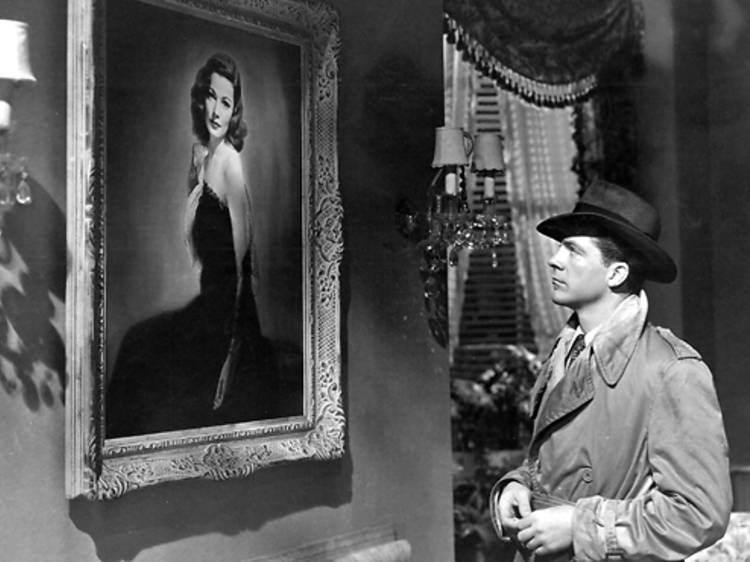
Scene from Laura, dir. Otto Preminger 1944
Kade Gajdusek
The Crying of Lot 49
By Thomas Pynchon
HarperCollins. 176 pp. $24.00
Last year, Thomas Pynchon published Shadow Ticket, his first novel in over a decade. It has the architecture of a detective story and the ornamentation of a period piece: a dejected private eye named Hicks McTaggart, a runaway cheese heiress, a Milwaukee turf war, a transatlantic chase into the fascist lowlands of 1930s Europe. But Hicks isn’t great at what he does, getting shuffled around a world he’s supposed to be investigating—by his boss, by a slipped mickey, by a coke-addled Viennese inspector—and the novel ends not with a revelation, but with a punishment: Hicks is exiled to an island between Yugoslavia and fascist Italy, stranded where his own lack of initiative delivered him. It's tempting to read this book as a kind of fable about what passivity costs a man in a world tipping toward fascism.
The apathy is strange coming from Pynchon, an author who made a living off paranoid novels that worked the opposite way: turning the reader into a detective himself, and leaving him to discover the book’s lessons on his own. The Crying of Lot 49 (1966), his slimmest novel, follows a housewife named Oedipa Maas who stumbles into what may or may not be a centuries-old conspiracy involving a shadowy postal service, a Jacobean revenge play, and the American unmoored. The plot resists being solved; Oedipa resists being sure; the reader is left to make the case, or not. What follows is a reading of the earlier book—an attempt to understand the singularity of Pynchon's detective fiction, and what exactly the new novel is turning away from.
Every hard-boiled detective story’s got the same yolk: A gravelly narrator coaxes the reader down into the sooty Los Angeles skyline, past coastal mansions where corrupt politicians live and Skid Row motels where their stooge attorneys spend their weekends, through power-plant pyres, zigzagging back-alleys, and finally to an empty parking lot at 3 A.M., where, the insomniac protagonist—an unflappable (yet deeply perturbed), tweed-suit-wearing, lone-wolf private detective—leans against the hood of his 1936 Plymouth, scattering cigarette ash on the streets of a city so far gone it might as well be lost. But a ciphered phone call about a missing girl, a stolen item, a duplicitous husband, or a cocktail of all three will oil his cantankerous limbs into motion, sending him on the urban quest. These instigating incidents (MacGuffins, in genre jargon) quickly lose relevance as the sleuth uncovers just how deep (and how high) the societal chicanery runs. More than a scramble to solve the initial mystery, the story becomes a test of character. He gets hit with bribes, beat-downs, and broken-hearted femme fatales waiting for him at hotel lobbies. The personally righteous detective encounters every opportunity to despair of his search, forsake his moral compass, and call it a night. Yet he persists, trying to square a crooked world.
Reading The Crying of Lot 49, the reader will quickly realize that the book does not adhere to the above conventions. For starters, the protagonist is comically under-equipped for her line of work. She notices everything, but understands nothing. Put her in charge of navigating a labyrinth of seemingly disparate events, and the result is a book without an exit. The story unravels into loose threads of historical confusion and semiotic combustion, leaving the reader with a dossier of conjectures and two leading questions: What, exactly, makes this book a detective novel, especially when it resolves so little? And if clear-cut answers are out of the question, why read on?
In 2014, Fredric Jameson wrote “Raymond Chandler: The Detections of Totality,” an essay that framed the titular detective novelist’s works as explorations of American social schemata. Jameson argued that a detective's unique job credentials allow him to explore and define spaces otherwise closed off to the general public. He encounters active resistance in the form of cronies and lawsuits rather than structural barriers like access or class. Brushing up against the oddities of each social space he enters, he can be “understood as an organ of perception, a membrane which, irritated, serves to indicate in its sensitivity the nature of the world around it.” His job is to be a cartographer, one who’s more concerned with drawing socio-economic and political contours than with putting a bow on the original mystery.
The Crying of Lot 49 is Pynchon’s postmodern classic about one woman’s attempt to execute a will. At the start, the narrator catches Oedipa Maas, a housewife living in a San Francisco suburb, returning home from a Tupperware party to find a letter informing her that her ex-lover, Pierce Inverarity, an uber-wealthy California real-estate developer she met when they were both undergrads at Cornell, has died—and has left her the co-executor of his estate. Grab on tight to those slivers of context, because they’re about all the specificity we get about Oedipa Maas. Beyond the bare biographical details of her occupation (housewife), place of residence (San Francisco suburb), marital status (stuck with a dubious disc jockey named Mucho Maas), and the odd fiduciary responsibility that has fallen to her, Oedipa Maas is faceless.
This apparent lack of characterization is at first off-putting. The traditional detective story begins with a full-frontal contextualization of the protagonist’s physical traits, moral constitution, and personal history. If the description omits anything, it’s most likely by construction—a reveal saved for later. As in any mode of storytelling, this overstated central character gives the audience something to hold onto in moments of confusion.When Pynchon spends only half a page on Oedipa’s context, it’s a clue that the book might lack a “shallow end.” Authors have notoriously used mirrors as a gimmick that introduces a character’s physical appearance. Oedipa, by contrast, “at some point went into the bathroom, tried to find her image in the mirror and couldn’t.” The glass had been shattered some time earlier by a jet-propelled can of hair spray. In other words, Pynchon smites the well-defined protagonist and leaves the form’s desecrated shards in the bathroom sink.
The all-gas-no-breaks style can make one hope for a clear-cut supporting cast and well-defined stakes, especially as Oedipa jets off to the zany world of San Narciso, a sordid, industrial parody of San Francisco (and a pun on “narcissism:” the city that loves itself). But, greeted at her motel by the womanizing co-executor and former child actor, Metzger, as well as the Paranoids, a Beatles-wannabe teenage rock band who sing in exaggerated faux-British accents, it becomes clear that the other characters will offer little relief. If anything, Metzger’s shady attempts at courtship (bordering on, if not just actually, assault), the Paranoid’s meta-textual love ballads, and the affair that finally comes of it all, only further decontextualize Oedipa. By the end of her dalliance, she has lost her marital status, one of the few traits she began with. So here’s the pattern: Characters with the potential to clarify the story wind up introducing more entropy. By the fortieth page, the unnerving ambiguity and eccentric encounters are too much to stomach.
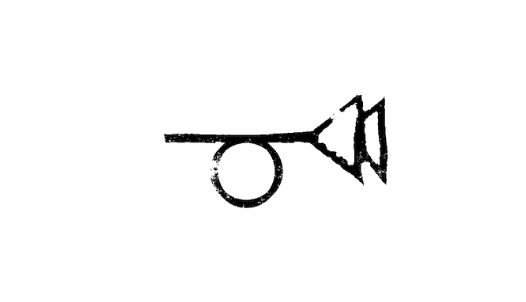
Luckily for everyone, Pynchon throws us a bone. A play introduces Oedipa to a clandestine postal service called Tristero. The group becomes Oedipa’s central fixation for the rest of the novel. The catch? No matter how much Oedipa investigates, she can’t be sure that Tristero is real, and there’s no one around with enough information to verify its existence.What follows is a series of peripatetic vignettes that drag Oedipa (and everyone else involved) along until the novel’s end. She stops at a bar called the Scope, a haunt for engineers from the aerospace defense industry. She heads to UC Berkeley, where she meets a professor studying Maxwell’s demon; then to a gay bar called The Greek Way, thronging with people practicing the art of loneliness; then to a laundromat that houses a delirious dying sailor. In each of these places, Oedipa encounters the acronym W.A.S.T.E. and a symbol of a muted post horn, both somehow tied to Tristero.
These encounters, hectic as they may appear in the moment, also carry with them a whiff of determinism, as if Oedipa’s path couldn’t have run any other way. For instance, when she fortuitously stumbles into Stanley Koteks, a Cold War weapons engineer for the Soviets, she says, “Hello there,” on a whim, adding, “‘Kirby sent me,’ this having been the name on the latrine wall”. When the latter piece of information actually persuades Koteks to open up, both Oedipa and the reader are liable to think: Really, you’re telling me that bullshit actually worked?
While the contrivance of these “chance” encounters might initially read as unconvincing, there is also an upshot to staying at the surface level. For Jameson, “the very superficiality of these meetings with characters is artistically motivated: for the characters themselves are pretexts for their speech, and the specialized nature of this speech is that it is somehow external, indicative of types, formulaic remarks bounced around to strangers.” For Oedipa, the reconstruction of West Coast social space is contingent on these oddly direct, semi-impersonal, but overall revealing conversations with others. Again and again, unfamiliar faces propel her towards the next clue on the other side of town. They too readily disclose information, and the result is a never-ending parallax to Tristero’s picture, a mirage we can never fully trust.
Pynchon writes no ordinary detective story. Instead, he seems to accept Jameson’s theory as a maxim. Oedipa is not uncovering new information so much as evaluating the information that drops into her lap. A new social arena, a new metonymous character, a new line of dialogue, and always new questions: Do they know what they’re talking about? Are we understanding each other? Am I coming to conclusions that are actually there? Am I making it all up?
As the book comes to an end, Oedipa goes on a meandering late-night walk around San Narciso, and Pynchon’s paragraphs get longer, his syntax even more garrulous, and his meaning harder to keep track of. The heroine can no longer stop herself from seeing muted post horns in every bar, and the W.A.S.T.E. acronym emblazoned on every bus. Still lucid but paranoid as ever, Oedipa lays out four possibilities: (1) Tristero is real, (2) she is hallucinating, (3) she is the victim of an elaborate, posthumous hoax by Pierce Inverarity, and (4) she has projected a fantasy onto random data.
At this point, the apophenic reader becomes an especially active participant, trying to reread Pynchon’s cipher to elucidate conclusions Oedipa has missed. Reading becomes a kind of multi-directional crossword, sending one flipping back and forth through pages to scrutinize characters, metaphors, locations, and anything else with a symbolic pulse. Intra-textual writings, songs, plays, and graffiti join the fray, either compounding the confusion or forcing it into a sudden, disquieting clarity. The detective becomes a reader, the crime a hermeneutic problem.
By the end, Oedipa tentatively takes Tristero to be a centuries-old postal system that has been running in secret ever since it was pushed underground by the Thurn and Taxis postal monopoly. Of course, none of this is corroborated by anyone else. The further Oedipa dives into the mystery of Tristero, the further she distances herself from her own trail of breadcrumbs. The book ends with her traveling to see the crying (read: auction) of Lot 49—a large collection of Invarity’s stamps that may hold the key to the secret postal system. She’s heard through the grapevine that an important anonymous buyer will be on site. Tristero? Pynchon ends the book before the gavel comes down.
The Crying of Lot 49 is devoid of resolution. It is a mystery that asks us to take out a pen and paper, jot down the entirety of Pynchon’s frenetic nouns, and see whether we can link them in any meaningful way. I tried to piece the plot together, to wrangle the constellation of stories and characters into an understandable narrative. But Pynchon allows no such clarity. Instead, the chicken scratches in my notebook seem more akin to Oedipa's paranoia than Archimedes’s eureka.
In Detecting Texts, Patricia Merivale and Susan Sweeney unite these considerations under a new title: the metaphysical detective story. To them, the metaphysical detective story “parodies or subverts traditional detective-story conventions … with the intention, or at least the effect of asking questions about mysteries of being and knowing which transcend the mere machinations of the mystery plot.” The metaphysical detective inherits the genre’s promise, believing that systematic investigation can, with enough effort, reach the truth, until they finally understand that the machinery of resolution doesn’t work. The sleuth fails not through incompetence but because the mystery is insolvable from within the system of interpretation the genre offers.
The cartographer no longer asks whether she has successfully mapped the territory. Instead, Oedipa ponders whether she is a cartographer at all. If there is a premise behind Pynchon’s madness, it is that if Oedipa is wont to search for narratives that don’t exist, so are we. As much as we want to believe that detective stories are reserved for credentialed sleuths, we as readers are just as engrossed in a Jamesonian project: The more we wander into unfamiliar areas with a passion for truth, the closer we get to revealing hidden social narratives, whether they exist or not. The joy of reading The Crying of Lot 49 is in forgetting the mystery and instead relishing in the evolving social scene. The concomitant discomfort comes from the unavoidable assumption that there must be more meaning, that we must be at the center of a narrative, that we still have some semblance of control.
Kade Gajdusek is still too dyslexic for crossword puzzles.