
A conversation between David Bromwich and Akhil Reed Amar.
Born Equal: Remaking America’s Constitution, 1840–1920.
By Akhil Reed Amar
Basic Books, 2025, 736 pp. $40.00
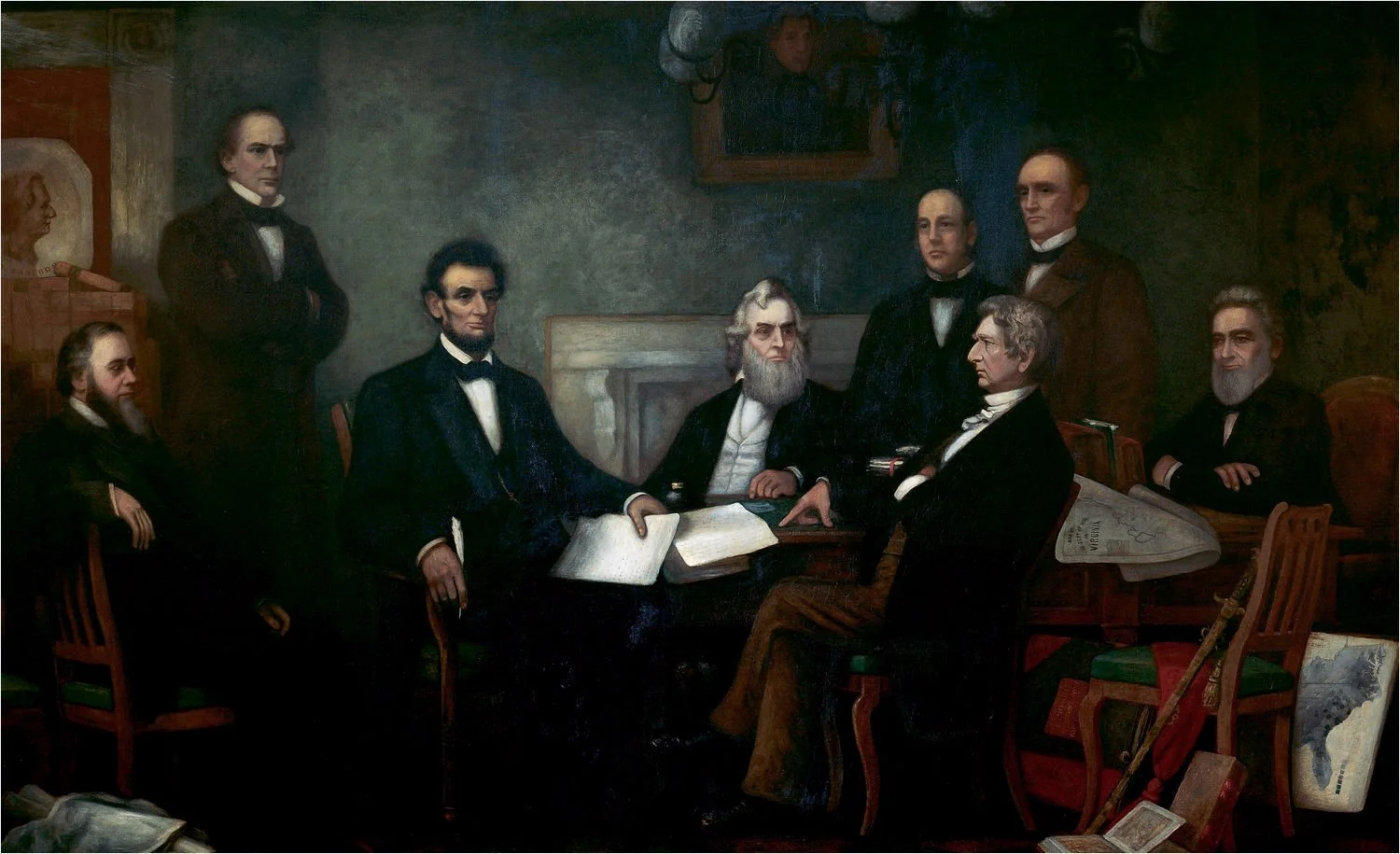
Francis Bicknell Carpenter, First Reading of the Emancipation Proclamation of President Lincoln, 1864.
When the Supreme Court overturned fifty years of judicial precedents on abortion rights in their 2022 Dobbs v. Jackson decision, hundreds in our Yale community were outraged. But how many of them knew whether, or could explain why, the Constitution confers a federal right to get an abortion? Whatever our normative beliefs about the decisions of this much-controverted, conservative Court, Akhil Reed Amar might argue, we remain, all of us, bound by the supreme law of this land, and our best bet in fighting bad precedents is not, in fact, to throw up our hands and scowl at the justices—but to study the law and its history, and especially its original meaning.
Amar, who teaches constitutional law at the Yale Law School and has published widely on the United States’ founding documents, describes himself as an “originalist.” Legal scholars of this camp look to the original intentions and early usages of laws to interpret their meaning. Amar stands out among them because he has often used originalist arguments to advocate left-of-center positions. Recently, he has defended the constitutionality of birthright citizenship in the Wall Street Journal, and opposed that of Trump’s tariffs in SCOTUSblog.
In his new book, Born Equal: Remaking America's Constitution, 1840–1920, the second volume in a projected trilogy, Amar traces a crucial period of progress in constitutional law, particularly with regard to the bundle of amendments—promulgated, above all, by Abraham Lincoln—that outlawed slavery in the United States and transformed the Constitution. An original framework of laws containing the fugitive slave clause and the three-fifths compromise became the document we know today, which protects Americans’ most fundamental rights, and protects them for all.
The book presents Lincoln as the nation's “foremost originalist” because he recognized a clear anti-slavery intention in the American founding, starting with the Declaration of Independence in 1776, and used it to argue for abolitionist policies. Amar shares Lincoln’s fundamental optimism about the American project, despite its flaws. And in this respect he differs from many other commentators on the Left, whose ethos is best embodied by the New York Times’ controversial 1619 Project.
BRINK organized a conversation between Amar and David Bromwich of the Yale English Department, who taught a seminar on Lincoln during the fall semester. The talk was attended by a small student audience from which Amar took questions at the end. The result has been edited for clarity and length.
—Matías Guevara Ruales, Editor-in-Chief
***
David Bromwich: Let me begin by describing this book as a revisionist history of the direction, the intention, that might be imputed to the Constitution—but also an interpretation that recognizes that the Constitution, in its ideal aim, was not complete until the abolition of slavery. There have been other historians who wrote about this under different descriptions. I'm thinking, for example, of James McPherson, who has a book called Abraham Lincoln and the Second American Revolution, as well as George Kateb and James Oakes. But what is interesting about your interpretation is that you use the word “originalism,” and you have some pretty dense and I think, in many particulars, new arguments to support your idea that you are really capturing the original intentions of the founders. So, two questions about this: What brought you to think of the abolition of slavery under that description of “originalism”? And how, and with what purpose of tone or polemic, did you arrive at that word? Because it's been used in a very different way by former Justice Antonin Scalia and a good many others.
Akhil Reed Amar: The big theme of this book is the Lincolnian Revolution, which will culminate in four amendments that I call the Birth Equality Amendments: the Thirteenth, the Fourteenth, the Fifteenth, and, many years later, the Nineteenth. These amendments grow out of Lincoln's party and Lincoln's project. And I do say, from the beginning, that Lincoln is an originalist, meaning he is claiming to go back to and to redeem America's origins. It’s in that famous sentence that we all know, “Four score and seven years ago our fathers brought forth upon this continent a new nation, conceived in liberty and dedicated to the proposition that all men are created equal.” So in 1863, at Gettysburg, Lincoln is going back 87 years; that takes him to 1776. He says that's the origin of America. It's a new nation, and it's not conceived in slavery. It's conceived in liberty. And at least one of its central propositions is that “all men are created equal,” and he claims that he's going to redeem that original vision.
Now, that original vision was actually a contested one. It brought together, in 1776, southern states as well as northern states. Lincoln has a northern interpretation of “all men are created equal.” In that interpretation he's standing on the shoulders of earlier folks, such as John Quincy Adams. You mentioned one great historian, Jim Oakes, definitely someone I have learned a great deal from; he talks about an abolitionist project that Lincoln inherits and ultimately consummates. The claim is that this project goes back to America's origins.
And here's what people in, let’s say, the 1619 camp miss: Abolition—Lincoln claims, I claim, Jim Oakes claims, Gordon Wood claims—is an American project. The ancient world has slavery in most continents at most times. It has an idea of freeing individual slaves, but it does not have the idea of ending slavery, of abolishing slavery. Jesus doesn't talk about abolition in the gospels, for example. Abolition in the world begins with the American Revolution. The world's first abolition society is formed in 1775 in Philadelphia. Its presidents will soon be Benjamin Franklin and Benjamin Rush, who signed the Declaration of Independence. And immediately after the Declaration of Independence, northern states including Pennsylvania and Massachusetts—to pick two, but two really important ones—are going to have state constitutions that begin with versions of the following sentence: “all men are born free and equal”; “all men are born equally free and independent.”
Lots of people—you mentioned Justice Scalia—can claim to be originalists. But whether they are in fact is a nice question. The true originalists are the people who really do the history, and Lincoln studied history quite a lot. So get out of your head the idea that originalists today are only conservative folks. Justice Scalia was, in my view, a poser. He talked the talk but he knew no history whatsoever. Anyone can call himself an originalist. Scalia didn't do the work. Lincoln did.
DB: Four score and seven years ago takes us back not to the ratification of the Constitution but, as you said, to the Declaration of Independence. Oakes and others point out that the Declaration of Independence was important to Americans, but it didn't have the central, commanding importance that Lincoln assigns to it. And in fact, some pro-slavery figures like John C. Calhoun and Alexander Stephens, who became the vice president of the Confederacy, had very little reverence towards the words “all men are created equal” or towards the Declaration. They both basically said, Thomas Jefferson really did write those words, and he really did mean all people, all men and all people, but he was mistaken. He was just wrong. And that's a very possible American view in the 1840s and on into Lincoln's time.
Say a little more about why you think Lincoln was right to interpret the Constitution through the Declaration of Independence.
ARA: Lincoln wants to unify—you’re absolutely right—the Declaration and the Constitution. He says that the “nation” is founded in 1776. So he is appealing to the idea that even before the Constitution of 1787–88, there were Articles of Confederation; there was a Confederation Congress; America becomes, juridically, an entity in the world that can make war and make peace in 1776. So that's when the nation begins.
And you and I have both read, for example, the Cooper Union address, where, wow, Lincoln has done his homework! Going back now not to just the Declaration but to the framers of the Constitution itself. And it's a very originalist argument he makes in that talk about what the individual signers of the Constitution meant.
DB: He's supposed to have done six weeks or so of homework writing that talk, which he brought east to give, at the invitation of Henry Ward Beecher. The Eastern establishment come to listen, and it's their first glimpse of this man of the West—Illinois, the California of that time—where they can say, all right, he's not an amateur. This is somebody who's thoughtful, and cogent, and knows how to reason prudentially, too. And he does bring up, as you say, in the Cooper Institute speech—he traces the history of the votes, subsequent to the ratification of the Constitution, of a credible plurality of the signers. Their votes are against slavery over the next generation when they're still in action, whereas there's only a tiny number who are voting for slavery. So that's part of it.
ARA: And David, that's an originalist kind of move, going through, framer by framer by framer. He's not making just an argument about the justice of abolition or why it would be an economically sensible thing to do. He's going back to the beginning, to the origins, to Philadelphia, and, framer by framer by framer, he is, in effect, making arguments about what they originally intended.
DB: You talk at some length about the continuity between Lincoln and the contents of the Fourteenth Amendment, which has been used so much in later jurisprudence that I'm interested to know—partly because of the current importance of birthright citizenship—how you regard the original sense of the nation and national citizenship as an element of the Fourteenth Amendment, properly understood.
ARA: What I try to do in this book—because wow, tons have been written about the Fourteenth Amendment—is give you a slightly different take from those of other historians or lawyers. I walk you through the text of all five sections of the Fourteenth Amendment, and I try to show not what each person said about that provision when it was pending in 1866 and 1867, but how it really was the culmination of arguments that had emerged over the 25 preceding years.
Jim Oakes, whom we evoked before, is saying that the anti-slavery folks have developed an anti-slavery project. So they have their talking points; they have their means; they know what they want to do if they finally ever win. It's like Project 2025 today. So the Fourteenth Amendment, when you go through it that way, you can see, click, click, click, how it's actually a fulfillment of this project that Lincoln brings to fruition by forging a broad coalition of the Left. There’s moderate anti-slavery folks, for example, who don't like slavery because they don't like slaves, because they don't like Black people. That's David Wilmot at the far conservative end of this coalition. And there’s radical utopian religious abolitionists. So it's a very broad coalition. Lincoln holds them together. His big theme in getting elected is, “no slavery in the West,” but as the Civil War proceeds, he'll move further and further, and will move from “no slavery in the West” to “no slavery anywhere.” That's going to be the Thirteenth Amendment.
In the Lincoln-Douglas debates, he says, “I am not in favor of Negro citizenship.” But eventually, the Fourteenth Amendment is going to provide equal citizenship for Blacks, and the Fifteenth, equal voting rights. So Lincoln is moving along a gradient here, and I'm tracing, in my chapter on the amendments, how they connect to not just the politics of the immediate moment, but to a larger anti-slavery project that congeals with Lincoln's election.
DB: You give a great deal of attention to at least half a dozen Supreme Court decisions in this book, but one that doesn't get as much as some other authors give it is the Dred Scott decision. The part of that decision that's most relevant to us looking back said that the American constitutional framers never meant for Negroes to be citizens; but Lincoln in his speech in Peoria on the Kansas-Nebraska Bill points out that there were Negroes voting as citizens in the first American elections as soon as the Constitution was ratified, so there's a kind of historical indifference in Chief Justice Taney's majority opinion.
You quote in the book a speech by Lincoln from July 10, 1858, that has some pertinence to the way one thinks about pushing back against bad tendencies going on at present, whether they have their derivation from a distant past or from more recent turns. Lincoln says:
Somebody has to reverse [the Dred Scott] decision, since it is made, and we [the new Republican Party] mean to reverse it, and we mean to do it peaceably. What are the uses of decisions of courts? They have two uses. First, they decide upon the question before the court. They decide in this case that Dred Scott is a slave. Nobody resists that. Not only that, but they say that when a question comes up upon another person, it will be so decided again, unless the court decides in another way, unless the court overrules its decision. Well, we mean to do what we can to have the court decide the other way.
Talk about this in relation to later court decisions, including right up to the moment, and the way people can work towards having them reversed or modified. Because it seems to me there's a great battle going on right now about the authority of the Supreme Court, and the way that the three parts of government are out of balance. And Lincoln seems to have been as up in arms about the Dred Scott decision as anybody can be about any decision, and yet he takes this line.
ARA: Lincoln is a consummate lawyer. In one sense he's saying, well, there was a case. It involved Dred Scott and John F. A. Sanford, and the ruling was that Sanford owns Dred Scott, and done is done. Lincoln is not proposing to get a mob together and liberate Dred Scott. That case is decided between the parties. That's what lawyers call res judicata, a thing adjudicated. But he's saying, as a precedent going forward, that's very different. And in the next case, we want the Court to say, for example, that slavery can be prohibited in the territories. Justice Taney says, oh, Congress can't prohibit slavery in the territories. But in the Cooper Union address, Lincoln says, look at all these founders who believed in prohibiting slavery in the Northwest and elsewhere, so Taney just made that up! So going forward, we, the new Republicans, are going to try to generate a test case that will give you, the Supreme Court, the opportunity to reverse yourselves.
Now let's take things today. My brother Vikram clerked for Harry Blackmun, who wrote the Roe v. Wade decision. Vikram is pro-choice. I'm personally pro-choice too. But we actually think that Roe v. Wade was not particularly well-reasoned. Lots of other people agreed, some who were pro-choice, some who were pro-life. And what people who disagreed with the Roe decision did was push and push and push, with new laws that would generate new test cases, until, in the Dobbs ruling, the court overturned Roe v. Wade. That's the sort of thing that Lincoln was trying to do way back when it could be done to Dred Scott.
Now let me take an example from the Left. The Supreme Court has really cut back recently on Congress's power to protect voting rights under Section 5 of the Fourteenth Amendment and Section 2 of the Fifteenth Amendment. A Lincolnian would say that Congress should keep passing laws affirming voting rights and force the Supreme Court to either double down on this, even though they were wrong, or to correct their mistake. So this is a game that both sides can play, but Lincoln and others are saying that the highest card, the ace of spades, so to speak, is not precedent, but what the Constitution actually says, as originally understood.
DB: Doesn't that method of cure depend not only on legal skill and respect for the law but also on a substantial number of people from the past being on your side? Doesn't the optimism we can associate with originalism depend on a certain ballast of the original framers having taken humane and liberating views? And aren’t there issues where that's just not true, and where, in fact, there's nothing but precedent on the wrong side?
ARA: Well, let's take an example from Lincoln. He faces a Constitution that has a clause called the fugitive slave clause, which says that when a slave escapes from a slave jurisdiction to a free jurisdiction, the free jurisdiction has to send the slave back.
Now, Lincoln hates slavery. He actually says, “I hate slavery.” He says, “if slavery is not wrong, nothing is wrong. I cannot remember a time when I did not so think and feel.” It's visceral for him. And yet, and yet, and yet, in his inaugural address, he says, “I admit that this clause exists. It is scarcely questioned that this provision was intended, by those who made it, for the reclaiming of what we call fugitive slaves. And the intention of the lawgiver is the law.” He's going to enforce this, because history won't always give us the answer that we want it to.
So here's his resolution: history and the text won't always be on our side. When they’re not, we’ll honestly follow what the Constitution says, but we will try to change it, in the long run. Slavery is wrong. If slavery is not wrong, nothing is wrong. And yet it's a deep part of this country’s way of life. Thesis, antithesis. His synthesis is: we must put it on a path of ultimate extinction.
DB: We heard a lot in the first days of the first Trump administration from Democrats about the importance of “resistance,” a Lockean word, which can include physical resistance. We also hear a lot of it now in Trump's second term. This talk of resistance can wear people down to the point where they think there's nothing available to us anymore but a resort to force, whereas democratic constitutional mores suggest, more in line with your thinking, that opposition is a different discipline from resistance. Would you talk about that distinction and the way Lincoln works it out?
ARA: Let me read to you what Lincoln says about John Brown's raid in 1859, which was a really big precipitating event, a bombshell. John Brown wants to take the law into his own hands and try to end slavery by force. He says it’s an evil institution, and well, let’s destroy it by force of arms. And there are some people on the far-left wing of the anti-slavery coalition who are sympathetic to this, people like William Lloyd Garrison and Wendell Phillips. Here's what Lincoln says, “I believe the attack of Brown wrong for two reasons. First, it was a violation of law. Second, it was, as all such attacks must be, futile as far as any effect it might have on the extinction of a great evil.” And now listen to the originalist language with which he sums up, “We have a means provided for the expression of our belief in regard to slavery. It is through the ballot box, the peaceful method provided by the Constitution. John Brown has shown great courage, rare unselfishness, as even Virginia's pro-slavery Governor Wise testifies. But no man, North or South, can approve of violence or crime.” So he's very much a legalist, saying the way to do this is the way the framers provided, namely through the ballot box.
Lincoln will enforce the fugitive slave clause even though it doesn't explicitly say “slave.” But he also says, they didn't say “slave.” They didn't use the word because they were ashamed of slavery. And let's take that seriously and let's redeem the best part of their project.
DB: The floor is open for questions. There’s lots to say.
Student Question: I was wondering what is the normative case for originalism? Why ought we be originalists? And do you think that the case for originalism is necessarily an argument for gradualism? Is it one in which we benefit from structures that have continuity?
ARA: Originalism is not at all gradualistic in every situation. It can result in dramatic overturnings of decades of precedent. In the name of originalism, fifty years of reproductive-rights jurisprudence was tossed on the ash heap. In the name of originalism, in effect, the Warren court tossed overboard Plessy v. Ferguson, because they said, led by Hugo Black and others, “it says ‘equal.’ Segregation is not equal, so Plessy must go.” That's fifty years of jurisprudence. In the name of originalism, the Warren court revolutionized constitutional law by tossing overboard lots of precedents.
What is the case for originalism? Well, I think the alternative is worshiping the precedents. And as imperfect as the Constitution has been, the judges have been worse. The Constitution did have pro-slavery elements. Oh, but Dred Scott was preposterous! The Constitution after the Civil War says “equal,” but Plessy doesn't do that. The precedents don't do that. The Fourteenth Amendment says you have all sorts of basic civil rights, and courts don't enforce that for the longest time.
So the consequentialist argument is just that if you look back at American history, the Constitution is imperfect, but actually it's the least imperfect thing we could commit ourselves to, because the main alternatives are precedents, or just wise judges should do whatever they want. Well, the judges aren't so wise. And the precedents aren't so good. That's the consequentialist claim.
The bigger claim is that the Constitution is what we promise to follow. If you're the President, the first thing you do is to swear an oath to preserve, protect and defend the Constitution, not the precedents. If you are any public official, you swear an oath to follow the Constitution. And we could get rid of all that. We could have a practice in which everyone crosses their fingers, so to speak, and everyone knows that they are purporting to take an oath to the Constitution, but they aren’t really. But that's not American culture. We don't, in fact, sneer at the oath as we take it. So I say, if we're going to promise to obey the Constitution, well, that's what we should obey.
And we can amend it. That's Lincoln's idea. He's not going to ignore the fugitive slave clause, and just interpret it away in a winking fashion. He's 'Honest Abe.' That's his moniker, and it's earned. He actually is a pretty honest guy, as politicians go.
Q: With regard to that originalist method of cure, of challenging the Supreme Court by bringing around some piece of legislation that provides an opportunity for the Court to be tested, that seems to require that the Court be susceptible to a test. There needs to be something going on—people advocating in some way, maybe there's been an eloquent speech by Lincoln or something—that is making minds turn in the Court and in the general public. So although originalism has this fixed idea of the Constitution, doesn’t it still depend upon some kind of contemporary movement to make minds turn?
ARA: In order for the whole system to work, in order for courts, for example, to repudiate erroneous precedents, yes, you're going to need a culture in which ordinary people, not just judges, not just lawyers, but ordinary people, learn about the Constitution and care about it. It's not about Lincoln's eloquence. There are many eloquent people in the world. But it's ultimately going to turn on whether he's got his facts right, whether, when he says all these people really did believe that Congress could prohibit slavery in the territories, he's right about that. I think he is.
And getting the text of the Constitution right and the history right is going to depend, in turn, on a broader culture in which people care about the Constitution and know about it. And that's why I'm writing these books, because right now, I'm not sure we have such a culture. Well, if we don't have that culture, then the justices can do whatever they want, because people won't be holding them accountable, because they won't know what the Constitution really says and doesn't say, and what the history really was and wasn't. Ultimately, originalism, the Constitution, none of it works unless we actually know the story.
David Bromwich is Sterling Professor of English at Yale and a faculty advisor of BRINK.
Akhil Reed Amar is Sterling Professor of Law and Political Science at Yale. He teaches classes on the Constitution in both the college and the law school.