
Ashley Wang
Palaver
By Bryan Washington
Farrar, Straus and Giroux. 336 pp. $28.00
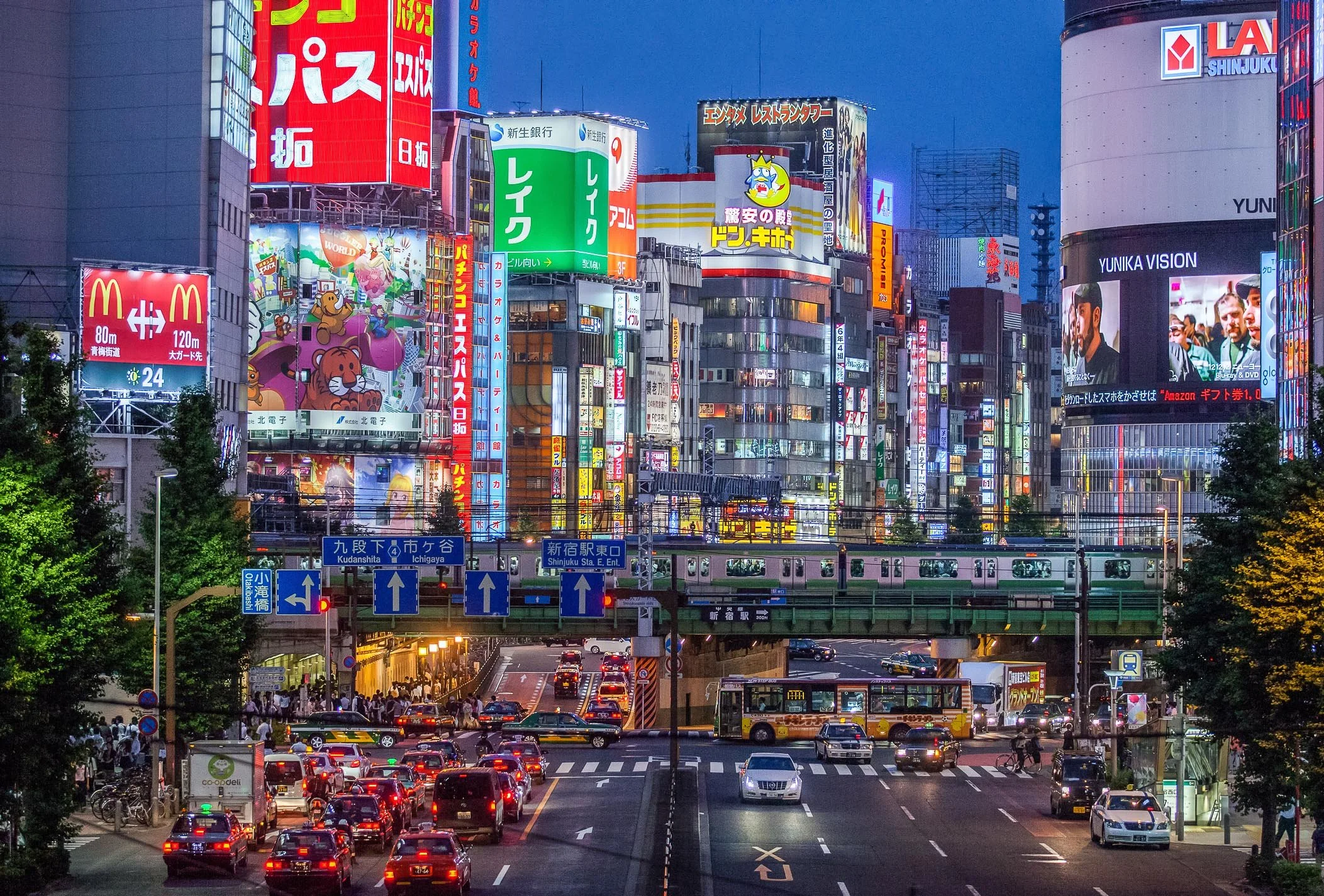
Shinjuku, Tokyo.
Bryan Washington’s Palaver holds the reader at arm’s length. The novel’s first few scenes are a tour de force of disorientation. We traverse the streets of Tokyo through a Jamaican-American woman’s eyes. “Each building sat low and square and neutral, dulled in maroons and grays, working against her.” The woman, who speaks only English and Jamaican patois, cannot understand the Japanese signage around her. When she drifts indoors, Tokyo only bears more indecipherable fruits: her son, the novel’s protagonist, whom she has flown from Houston to visit, remains obstinately withdrawn from her. The prose, too, adopts a sense of estrangement. Everything is filtered through the third person: the protagonist is only ever referred to as “the son,” the woman only ever as “the mother.” Their dialogue is laid bare on the page. No quotation marks. No fancy phrases. Only curt remarks and intermittent cursing. Speech adopts a strange kind of permeability as all characters’ voices are flattened into the same clipped cadence.
Such are the conditions of life in the world’s biggest city: mundane routine, hollow relationships, and a muted awareness of passersby amid a deluge of neon signs. The attachments these characters do manage to form are terse; they lack emotion. The son and a married Japanese salaryman named Taku intercept each other at Shinjuku Station, as any two commuters might at the city’s busiest stop, then proceed wordlessly towards a love motel for sex. Washington’s signature restraint—honed in his previous novel, Memorial, and his short story collection, Lot—reaches its full potential in Palaver. In Tokyo, nothing holds. No attachment retains significance. “They weren’t each other’s best fucks, nor were they their most timid. But they’d learned each other’s bodies—knew when to accelerate, and when to escalate, and how to make the other succumb.” The pair perform a familiar script, leaving little room for genuine eroticism. The divide between the public and private spheres has all but dissolved. Ambivalence oozes from the train station into the bed.
Washington’s portrait of disaffection represents queer alienation writ large. To be queer, Washington convincingly urges, is to be foreign everywhere. When you are a perpetual outsider, unmoored from every nation, is there really a difference between fucking a fellow American or a married Japanese salaryman?
If Palaver’s metropolis of queer estrangement is so compelling, it is largely thanks to Washington’s own experience living as an American expat in Japan. In an essay for Catapult, the author describes the disbelief many white Americans show whenever he talks about visiting Osaka: “what they meant, invariably, was: ‘How could you imagine yourself somewhere we couldn’t imagine you?’” For Washington, Japan became the negative ideal of a homeland, allowing him to embrace his perpetual foreignness as a Black, queer man from Houston. Similarly, Palaver’s characters are wandering castaways. They aimlessly float around Tokyo, foiling the compulsive obsession with progress found in much of American contemporary fiction.
It is this mode of meandering, beyond the imposition of a plot, that bolsters the first half of Palaver. Washington resists easy binaries, continually troubling every relation and space the son enters: he flees America for Tokyo to be out and proud, but finds himself in a furtive extramarital affair; he enters a drinking binge after being ghosted by Taku , but a trans bartender comes to the rescue. These makeshift flings still cannot compensate for his deep loneliness, so after ten years of silence, he calls on his mother to save him from the city. She arrives faithfully at his doorstep, only for him to avoid her.
When even familial relations come undone, where does the individual turn for refuge? For the son, the answer is the interiors of Tokyo—living rooms, parlors, kitchens. Palaver’s tenderest moments happen in Taku’s living room. In a scene that sets us up to expect an eruption of violence against the son—Taku’s son crying in a cot, his wife at the door—the protagonist is met instead with unconditional love. Aiko, Taku’s wife, welcomes him into their apartment like a prodigal son. “I actually invited you,” she says to the flustered American her husband has been sleeping with. Later, she confesses her gratitude to him: “I’m actually happy that you’re a part of his life… Taku’s a pretty lonely guy.” Here, Palaver offers a quietly radical notion: the nuclear family does not always have to be a restrictive structure that forecloses all possibility of queerness.
But when Washington turns his lens outward, moving from Taku’s apartment to the bustling streets and bars of the city, Palaver starts to feel shakier.
In an inversion of Manifest Destiny, the stereotypical path of American queer liberation runs east, toward the unruly, oblique angles of globalized cities. In his 2005 book, In a Queer Time and Place, cultural theorist Jack Halberstam characterizes this literary-cultural narrative as “metronormativity”: from Boys Don’t Cry to Giovanni’s Room, the rural village is a hostile spatial closet from which the queer person must emerge. To become truly free, truly at home in their body, they must depart from their hometown and dissolve into the big city’s multicultural soup of Others.
Palaver adds a globalizing twist to this trope: Tokyo, in Washington’s hands, morphs from the capital of Japan into a many-headed hydra of nationalities. Cast all too often as a techno-orientalist symbol of the future, the city becomes an aspirational world—a better version of America’s multiculturalist promises. The son’s apartment is next to a Taiwanese restaurant, a Chinese acupuncturist, and a French bistro run by a Japanese chef who has by turns lived in Paris, Berlin, San Francisco, and Canada.
This dizzying cosmopolitanism is exhilarating at first, but Washington’s long lists of proper nouns eventually start to feel forced. Even toward the end of the novel, the page is still dotted with the names of new hidden locales. On the way to his lover Tej’s apartment, the son shimmies down a road “lined with Iraqi and Pakistani and Indian grocers, flanked farther down by a Palestinian restaurant,” but these sites are only granted the throwaway gesture of naming. The pita the son buys from the restaurant is half-finished—extracted from a plastic takeout bag, chewed, then thrown back into a plastic trash bag—the product of Palestinian culture barely digested. Palaver’s storefronts ultimately compose a series of still tableaus, flattening life. The son waves at two men through the Palestinian restaurant’s window, then leaves without ever evoking them again.
It is in these moments that Palaver reads the weakest, plastering the consciousness of the cultured “global citizen”—he who is willing to indulge in hummus as much as in konbini meals—over Tokyo. Despite its aspirations of multiculturalism, the book is situated entirely in English. It is no wonder, then, that its main characters barely skim the surface of the city, capable of sustaining only brief interactions with service workers or ESL students. Mother and son both form genuine relationships with Japanese locals, but these acquaintances always harbor some tie to the West: Aiko is from Seattle; the mother’s local love interest, Ben, spent his formative years in Berlin and Canada.
Palaver wants the reader to believe Tokyo is a singular haven for the queer fledgling, allowing him to form precious kinships with other expats. But when the districts of Shinjuku and Koenji are smeared over with English, this attempt rings hollow. Take the following scene, set during a New Year’s Eve party:
Seemingly every other queer in the Tokyo region had found their way to the dance floor. Dua Lipa yelled about the improbability of love overhead. The floor below them squealed from sweat and split liquor. And the son wondered, briefly, if he could’ve found this scene anywhere else in the world.
Tokyo, by this point, is less a metaphor for queer alienation and more a utopic ideal lacking in geographic and historical consciousness. Washington’s rendition of the city amounts to idealized gay bars—Anglophone microcosms of the world where expats from Nepal, Brazil, and America can dance to a song by one of the West’s most famous pop stars.
Washington has written beautifully about cities before. Critics consistently praise his ability to transform his hometown of Houston from a suburban sprawl into clusters of dense buildings spilling over with life. His previous work has often rendered immigrant populations with maximalist flair. In Lot, Washington writes about “our Thais and our Mexicans and our Vietnamese. Some Guatemalans. The Cubans.” In the Houston of that novel, characters have a near-omniscient knowledge of their neighbors' histories and daily routines—fútbol games, evening gossip, Ice Cube listening parties—which coalesce into a convincing collective. The neighborhood breathes.
The key difference here is that Lot’s Houston enclaves are made available to the reader. But Palaver, helpless as it is in its attempt to access local Tokyo life, falls into the same trap as Sofia Coppola’s Tokyo-set movie, Lost in Translation, presenting the city as an exotic ground from which Western romance can blossom. Washington’s characters certainly form deeper connections with Tokyo than Coppola's passing tourists, and their problems are far more serious than a waning star’s dissatisfaction with life, but they, too, pave over the East. They treat it as personal fiction against which to identify themselves. Mother and son both build genuine romantic entanglements with Japanese locals, but these affairs are temporary: Taku must return to his family, the mother must return home.
Perhaps this is why Palaver deflates, despite its potential. For all of Washington’s attention to the messiness of queer kinship, he ultimately tries to resolve his characters’ troubles by tying them with a neat rainbow ribbon. The novel’s narrative, marked mostly by the mundanity of routine, suddenly picks up speed in the last quarter. The plot surges forward, fuelled by catastrophe: first a car crash, then an earthquake. Both of these events feel rather perfunctory—facile pretexts to set up scenes of reconciliation. Amid the tremors, the son runs to Aiko and Taku’s apartment, and Washington uses this moment as an opportunity to further complicate their triangular relationship, reconfiguring the protagonist as a kind of co-parent. While it is somewhat moving to witness the son holding the couple’s child in his arms, their three-way declaration of “I love you” is ultimately unconvincing, propped up with nothing but a sentimental desire for reconciliation. In his attempt to construct an atmosphere of “radical okayness” (a term Washington coined during a podcast conversation with Ocean Vuong), the author strains his story’s credibility. It is difficult to imagine this hyperbolically triumphant scene: who could buy the image of a lavender couple co-parenting their infant son with their homewrecker?
In Palaver, the ideal queer subject is a migrant, one foot on his provincial past and the other stepping toward his cosmopolitan future. Migration is the undercurrent of the erotic; self-actualization happens in moments of syncretism, in the beats between a Leslie Cheung ballad and Dua Lipa’s disco jibe. But having sidelined its Japanese subjects, the novel fails to deliver on its promises of cross-cultural queer kinship.
In Cruising Utopia, José Esteban Muñoz conceives of queerness as a future-oriented phenomenon, a window into better worlds yet to come. Utopia, Muñoz argues, can never be found in the stagnant present. Instead, it appears as a “temporal disorganization,” in which the “here and the now is transcended by a then and a there.” Perhaps it is not multiculturalism, then, or a universally shared language, that leads to paradise. Instead, the answer lies somewhere in the undeveloped center of Palaver, amid the dissolution of language. When, seemingly out of nowhere, the son starts “forgetting his words,” the past roars into view, revealing the real roots of his alienation: a traumatic home life marred by homophobia and an absent father. Fuelled by anxiety and the propulsive force of the past, the son’s inability to speak pushes against the stultifying nature of his life. And when his mother arrives, love crystallizes in the calculated distances between them, as son watches estranged mother, and mother watches estranged son. Their mutual devotion emerges in silence. Therein lies the source of Palaver’s unrealized potential: the gaps are what matter. They do not need to be closed.
Ashley Wang is from Hong Kong. She wants to make a map of every city.