Gerontocracy in America
By Samuel Moyn
Farrar, Straus and Giroux. 288 pp. $30.00 (On sale June 16, 2026.)
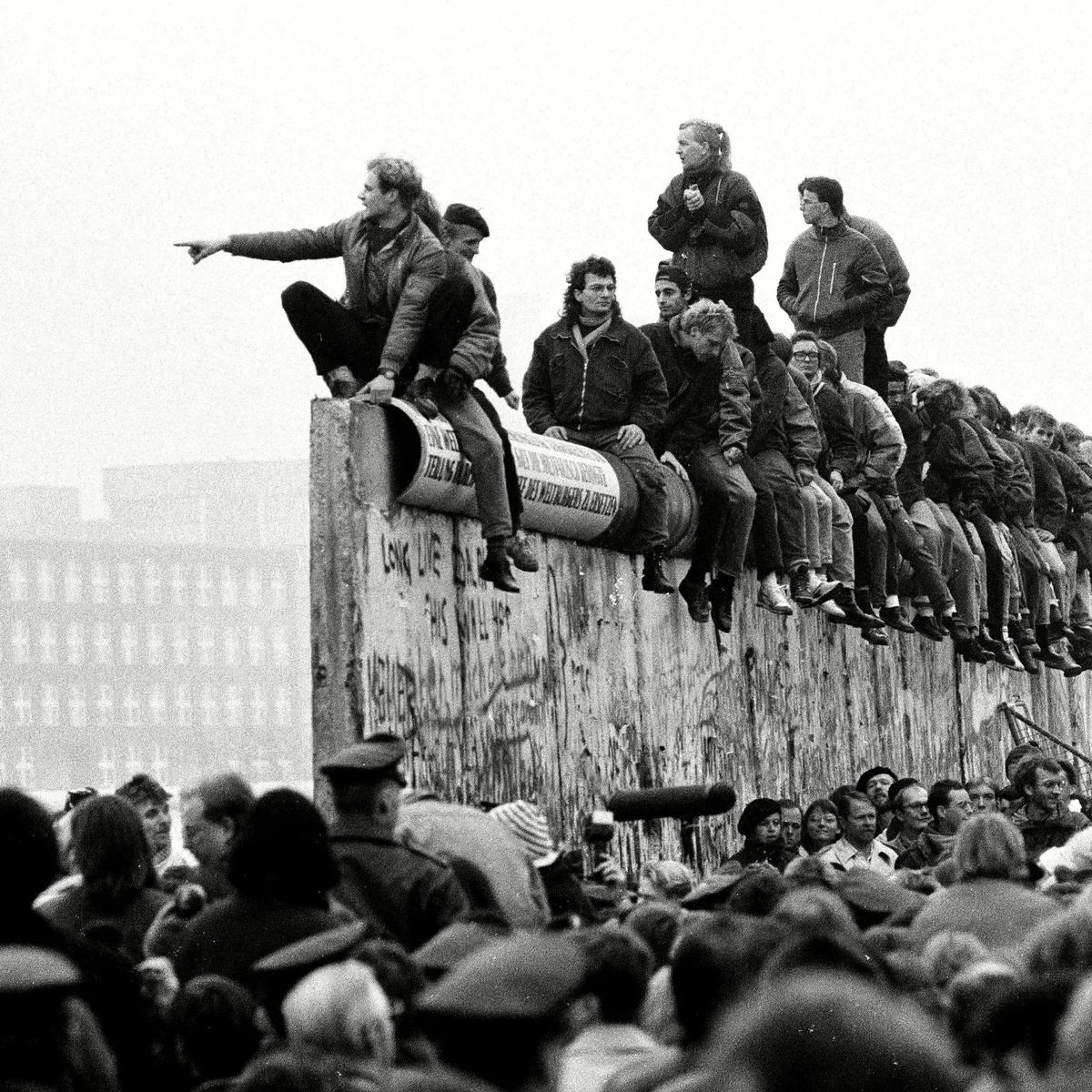
Peter Horvath, East and West Germans celebrating the fall of the Berlin Wall, November 10, 1989.
Reclining in the living room of the Grace Hopper Head of College house at Yale, button-down tucked under an unassuming navy quarter-zip, Samuel Moyn projects more as an armchair theorist than a thinker who has spent his career hunting big game. But appearances deceive. Over the past decade, Moyn’s targets have included human-rights theories that justify interventionism, moral frameworks that legitimize inequality by adopting narrow, rights-based definitions of justice, and the militarizing effects of America’s post-Vietnam efforts to ‘humanize’ war.
Most recently, in his 2023 Liberalism Against Itself, Moyn argues that Cold War-era liberal thinkers betrayed liberalism’s early ideals of self-determination and creative self-development in favor of a defensive creed that defined freedom exclusively as the absence of interference. In so doing, they paved the way for a hollowed-out liberalism, and therefore bear significant responsibility for the recent rise of illiberal movements. Moyn’s forthcoming book, Gerontocracy in America: How the Old Are Hoarding Power and Wealth—and What to Do About It (out in June), extends his critique of the liberal status quo by tracing the political, social, and existential consequences of the growing dominion of the elderly over American life.
Over two conversations, I spoke to Moyn about these recent projects. We discussed the rationale behind his genealogy of liberalism, what the new politics of “abundance” gets right and wrong in its vision of liberal renewal, the ideal of creative individuality animating Moyn’s critique of gerontocracy, and the policy proposals he draws from that ideal. The result, lightly edited and reproduced below, is a window into how one of our leading intellectual historians is wrestling with liberalism’s past, present, and future.
—David Rosenbloom
***
David Rosenbloom: You have advocated for liberalism’s return to its “emancipatory foundations.” Why do you want to look backward rather than forward?
Samuel Moyn: I think there are two main reasons. First, a plausible history of liberalism suggests it did begin in a more emancipatory guise—not just concerned with non-interference but with self-creation and self-determination—before taking on a more pessimistic guise during and after the Cold War. Of course all historical narratives are constructions after the fact, but there is a fair bit of evidence that this kind of back-to-the-future move is legitimate.
The liberal thinkers I cite—Mill, Tocqueville, Constant—are good proofs. I think Mill was misread for decades, and still is, because Cold War liberalism turned him into a theorist of free speech and the limits of the state, when these were just instrumental conditions he thought necessary to ensure his real end: authentic, interesting, creative individuals.
The second reason is strategic. In America especially, there’s not a strong-enough Left to just present its own project, whether that’s a new version of liberalism or its own post-liberalism. So to broaden the appeal of an emancipatory project, it helps to show that liberalism can be one—and that it may even have been one from the start.
DR: Your strategic move might seem like an attempt to make liberalism more resilient by reconciling its contradictions. Is that how you see your project?
SM: I don’t think liberalism should expect or hope for a final resolution, for an end of history where all of its contradictions are resolved. My narrative is almost the reverse. I wouldn’t say that liberalism’s problems today are because it made promises that it hasn’t kept; I’d say that liberalism has for so long forgotten to promise and became unpopular for that reason. This, I think, is where today’s liberal crisis comes from. Liberals have so thoroughly lost their alliance with emancipation that people no longer expect liberals to promise anything at all.
That’s why I think a Donald Trump figure appeals, because he’s at least registering the disappointment with the liberal status quo, with the lack of promise that people are experiencing. And I think this is at a very basic level: for example, whether people think their children will have better lives than they have. So when Trump says the American Dream has been smashed, he’s exploiting the opportunity that liberal under-promising has created.
DR: Cold War liberals often argued that the kind of emancipatory politics you describe lies on a slippery slope towards a Rousseauian, “forced-to-be-free” kind of despotism, by enforcing a particular vision of the good life. What do you make of this critique?
SM: Well, to start, I’m not sure how fair the allegation that the Cold War liberals made was, because the politics they were defending was very much an emancipatory project as well: they supported the biggest, most interventionist, most redistributive liberal states there had ever been. In fact, the Cold War liberals of the sixties were anything but pessimistic or tragic. These were folks who killed millions in the name of their own alleged liberal utopia, who broke a lot of eggs to make their own omelets. Given their politics, they couldn’t actually believe emancipatory politics were inevitably a slippery slope.
So in a sense, I’m providing a very modest criticism of these thinkers: that they silently voted for social democracy but wrote as libertarians, decrying the Soviet Union without defending the emancipation they actually lived, thereby intellectually undermining something they in fact believed in. You wouldn’t know from reading Berlin that he’s a Labour voter who thought Franklin D. Roosevelt was the greatest liberal who ever lived, which he says in letters. Publicly, these thinkers didn’t stand up for social democracy, romantic individuality, Hegelian teleology, or other casualties of the libertarian redefinition of liberalism that they staged to scapegoat the Soviet Union. They were too complacent about how long the socialist components of their privately preferred social liberalism would last if they only talked about liberty as freedom from interference. Then, when people stopped voting for social democracy, their ideas proved very useful.
DR: What might a social liberalism of the sort you envision, the sort from which Cold War liberals turned away in their public writings, look like?
SM: The standard view is that 19th-century liberalism—through the new liberals in England and the progressives in the United States—essentially took on board Marx’s critique of classical liberalism, namely that unregulated economic freedom creates new, illiberal hierarchies. On this view, liberalism had to be rescued from economic liberalism through some kind of socialist or social-democratic foundation.
DR: You’re organizing a panel in the spring on Ezra Klein and Derek Thompson’s Abundance, a book that seems to have split the American Left. Some see it as a blueprint for ‘supply-side’ progressivism. Others say it evades crucial questions of power distribution, oligopoly, and the ends of innovation. Where do you situate yourself in that debate?
SM: Abundance gets many things right. One is existential: the importance of creativity, dynamism, and novelty. My beef is that it seems almost neo-Nietzschean, concerned only about those values for the few innovators, as if the mass of humanity will just receive abundance gratefully or provide services for the creative few. Still, it’s important to start with a Left that foregrounds creativity and dynamism rather than justice or care as its main concerns.
They’re also right to thematize production and a shift of liberals to the production side of political economy. But their proposal is just neoliberalism: getting government out of the way of creators and private industry. They assume that private forces can adequately create under their own power if the red tape is just cleared. That’s mostly just straight Reaganism or Hayekianism.
The goal would be to reimagine how government can sponsor, help plan, and spread creative capacity to people who don’t have it. America has never grown more than during the war economy, when the government owned half the factories and told the other half what to do. Government could have a huge role in abundance-type growth.
Nevertheless, Klein is right that freedom should be self-creation. So there’s a kernel of great importance in both the creative investment and the concern about production—not just the massification of enterprise, but returning to the questions: What is production? What makes it a source of novelty? And how do we spread that capacity to change things to more people?
DR: Your forthcoming book, out in June, tackles what you call “America’s gerontocracy problem.” Could you tell me about this project?
SM: The book tries to present the consequences of the entrenchment of wealth and power among the relatively older, across the political, electoral, and private or social spheres. Across these, however, my point has an existential, romantic side to it. Creativity has some biological foundations: when we’re young, our intelligence is more dynamic and plastic, able to make orthogonal moves; when we’re older, our intelligence is more about repetition and honing acquired skills. This means that, amidst our finitude, we have one chance to be creative, one chance we either seize or lose. Gerontocracy deprives us of the ability to seize that possibility for creativity and novelty.
DR: On the political side, the problem of gerontocracy also seems to me, frankly, a crisis of representation. To what extent is the book making an intervention on that front?
SM: The book is ethically pluralistic. So yes, there is certainly a critique that will resonate with those doing democratic theory.
But I think it's deeper than this. I try to show that gerontocracy has been the default mode in human history. If we take a modified Hegelian view, then humans enter history facing backwards, towards the past, towards preservation and repetition. That’s why we have, for example, ancestor worship and the enthronement of the old: those closest to the dead. So gerontocracy is not just the accumulation and wielding of power by the elderly, but a fundamental facing towards the past and towards history as authority, rather than looking ahead to the future as the thing we’re working towards. For me, again, the existential consequences of this are grave.
DR: Why should we strive for greater innovation and novelty in politics? For many of the Cold War liberals—I’m thinking of Berlin’s call to maintain an always “precarious equilibrium”—this is precisely what we ought not to do. How do you defend your call for political creativity against such criticism?
SM: These types of critiques are worthy views, but typically they are based on a sense of ineradicable pluralism about values. Figures like Berlin are oriented to pluralism almost nihilistically. They think there is no way of settling on any set of values as the highest ones and so everyone should be encouraged to pursue whatever they wish. I think we have to start with a monism about the unique value of creative self-invention. Of course, that leads to tolerance of creative alternatives and experiential pluralism, because everyone will be encouraged to run their own Millian experiments in living. But under this proposed value-monism, the main goal is not to keep us all together while protecting each of us, as it is for the Cold War liberals. It's to encourage creativity and novelty in the project of our lives.
But I guess if empirically it turned out that an experimental culture would be disastrous and have grievous consequences that undermine the possibility of even conducting personal experiments, then maybe I would have to reconsider. But as far as I can tell there’s not a ton of evidence to think that is, or would be, the case.
DR: The opposing view can also be Burkean: that we shouldn’t try to rush history through political novelty, because inherited institutions and norms embody practical knowledge, such that humane politics consists not in the creative construction of new ends, but of cautious reform within a slow, intergenerational conversation. What do you make of that position?
SM: I’m not making a case for revolutions. Edmund Burke himself was a Whig and a reformer, not a Tory, and that coexisted with his claim about the value of inherited political knowledge.
Nevertheless, I think he and his tradition overstate the accreted wisdom and understate the inherited oppression of existing institutions. I respect the point about speed; of course one can go too fast. But why is there not a similar worry about moving too slowly? That a snail’s pace can create new problems, or allow existing ones to perpetuate, to fester? The conservative view seems overly prejudicial to the extant reality. One of Marx’s most brilliant points was that if we’re going to debate the possibility of violence, let’s remember that society is already violent. In essence, the calculus is not safety now compared to a risk-injected situation later. We are always in a risk-versus-risk situation.
DR: How do you propose combating gerontocracy?
SM: My proposals map onto the different spheres of gerontocracy: political, electoral, and private or social. For the first, there are lots of easy proposals, like age limits for political office. I also propose chamber quotas for different age cohorts in representative bodies. For electoral gerontocracy, there would be easy things like compulsory voting, but also perhaps things like proxy voting and lowering the voting age. In fact, the Labour Party has committed to lowering the voting age to sixteen nationally, and in the U.S. there is an organization called Vote 16 that has already gotten some states to lower the municipal voting age to sixteen. Above all, one could consider correlating votes with the years one is expected to live under the chosen policies.
For social gerontocracy, there are various kinds of age-related taxation schemes I propose—not to hurt those who are old, but to oppose the entrenchment of elder power through wealth retention, especially landed wealth, and to encourage earlier transfer of assets down the generational chain. Also, mandatory retirement for those hoarding opportunities.
And to go back to our discussion about the speed of history, these proposals are not concerned with how fast social change should be brought about. It would be up to those who get more power under a renewed system to determine how fast we should go. The main idea is simply vesting more power in those who are more creative, those who are in their prime, who are able to make more orthogonal moves. It’s about recognizing the way that our life course has political consequences, and adjusting our politics accordingly.
DR: On the electoral gerontocracy front, I’m curious how you understand the relationship between youth and progressive voting patterns.
SM: There’s no doubt that, on balance, younger voters are less conservative in the small-c sense. Preserving the status quo or reviving some recently lost version of it is less frequently their aim. So, again, on average, the relation between innovation and plasticity is clear. Of course, that the less old are prone to change and risk doesn’t mean their goals are good. They could sponsor reactionary change, not just progressive change. But the hope for progress does depend on empowering them.
DR: Last question. What are you reading these days?
SM: Many of the most interesting works coming out are in Marxist theory. And I think you can’t be a serious liberal, as in the nineteenth and early twentieth century, without engaging with and learning from Marxism. For example, Jensen Suther’s new book True Materialism: Hegelian Marxism and the Modernist Struggle for Freedom, and Søren Mau’s Mute Compulsion: A Marxist Theory of the Economic Power of Capital. Lately I have been reading the magnum opus of something like my own mentor, Roberto Unger’s The World and Us. I’m also reading Morton Jensen’s The Master of Contradictions, a biography of The Magic Mountain and its making.
David Rosenbloom is a recent graduate of Saybrook College, the Copy Editor of BRINK, and an avid reader of Roget’s International Thesaurus, Seventh Edition.
Samuel Moyn is Kent Professor of Law and History and Head of Grace Hopper College at Yale.